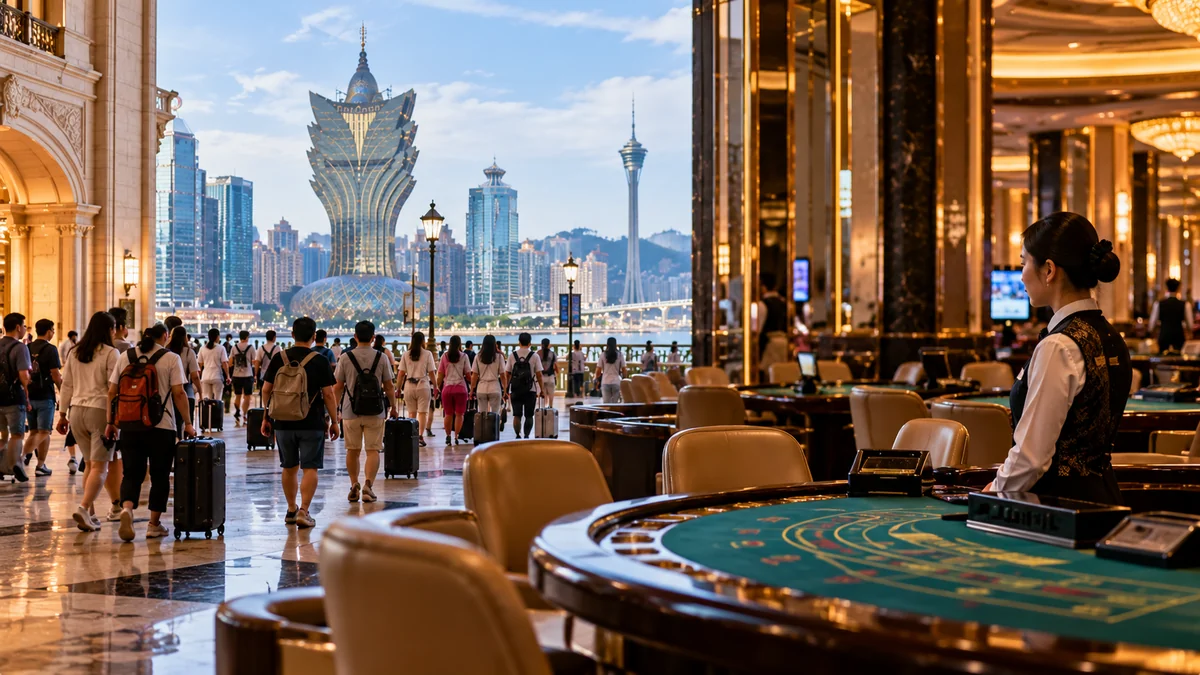
Macau welcomed more than 32.18 million visitors in the first nine months of 2026, an increase of 8.5% on last year. The casinos are not seeing the same growth. Gross gaming revenue is up only 3.2% for the year so far, it has fallen year-on-year for four months in a row, and the city's visitors are increasingly day-trippers who spend less time on the gaming floor.
Key takeaways
- January–September arrivals: 32,181,272, up 8.5% year-on-year.
- Year-to-date GGR: MOP187.12 billion (about US$23.19 billion), up only 3.2%.
- September: visitors +15.9%, GGR −1.2% to MOP18.06 billion, the lowest monthly total of 2026.
- Same-day visitors grew 14.5% over nine months; overnight stays were flat.
- Third-quarter GGR fell 3.8%, and analysts expect sector EBITDA to drop by about 11%.
More People, Less Gaming Revenue
Macau's latest tourism figures show a clear gap between the number of visitors and what they spend in the casinos. From January through September 2026, 32,181,272 people entered the city, 8.5% more than in the same period of 2025. Over the same nine months, casino gross gaming revenue reached MOP187.12 billion, about US$23.19 billion. That is still ahead of last year, but the 3.2% increase is well below the growth in visitor numbers.
The gap was widest in September. Arrivals rose 15.9% to 3,216,535, while GGR fell 1.2% to MOP18.06 billion, roughly US$2.24 billion. It was the fourth year-on-year decline in a row and the weakest month of the year so far, below June's previous low of MOP18.52 billion.
September is normally a quiet month in Macau. Summer travel ends, and many mainland visitors wait for the National Day Golden Week at the start of October. Even so, this year's result missed expectations. Early in the month some forecasts had called for double-digit growth. Weak table play during the month led brokerages to lower their estimates, and the final figure came in below even the revised consensus. Weaker premium mass play was the main reason.
Day-Trippers Are Driving the Growth
The breakdown of the visitor figures explains much of the gap. Most of the growth came from same-day visitors, who arrive and leave on the same day and spend fewer hours in the casinos.
In September, Macau recorded 1,933,257 same-day visitors, up 23.8% on a year earlier. Overnight arrivals rose only 5.7% to 1,283,278. The nine-month figures show the same pattern. Same-day visitors totalled 19,783,856, up 14.5%, while overnight visitors were broadly flat at 12,397,416.
Visitors are also staying for less time. For January to September, the average stay for all visitors fell by 0.1 day to 1.0 day, and overnight guests stayed an average of 2.3 days. In September the averages were 1.1 days for all visitors and 2.4 days for overnight guests, both 0.1 day lower than a year ago.
For casino operators this matters. Overnight guests book hotel rooms, eat in the resorts' restaurants and usually play longer table sessions, often in premium mass areas. Day-trippers from Zhuhai and the rest of the Greater Bay Area are more likely to visit the sights, shop and play only briefly. More arrivals do not necessarily mean more gaming revenue.
Macau at a glance: January–September 2026
| Metric | 9M 2026 | Change y-o-y |
|---|---|---|
| Total visitor arrivals | 32,181,272 | +8.5% |
| Same-day visitors | 19,783,856 | +14.5% |
| Overnight visitors | 12,397,416 | Broadly flat |
| Average length of stay | 1.0 day | −0.1 day |
| Gross gaming revenue | MOP187.12bn | +3.2% |
| September GGR | MOP18.06bn | −1.2% |
Revenue Growth Has Slowed All Year
The slowdown in gaming revenue has built up steadily since spring. Year-to-date GGR growth stood at 24.0% in January. Through May, cumulative revenue was still up 10.9%, but by the end of June growth had fallen to 6.8%. After a weak summer and a disappointing September it reached 3.2%.
Third-quarter GGR fell 3.8% year-on-year to roughly MOP60.2 billion, and mass baccarat revenue, the most important product for Macau's operators, dropped 7.9%. Brokerage CLSA expects third-quarter sector EBITDA to fall about 11% to around US$1.84 billion. It points to commissions and rebates rising to an estimated 20.7% of GGR from 18.6% a year earlier, and to higher operating costs. CLSA is neutral on the sector for the next six months. It expects GGR to fall about 1% in the fourth quarter and to grow around 2% in 2027.
Mainland China Still Dominates
Mainland China remains by far Macau's largest source market. Mainland arrivals for the nine months rose 10.7% to 23,884,916, about three in every four visitors. Of these, 13,153,979 travelled under the Individual Visit Scheme, up 14.3%. Under this scheme, residents of eligible mainland cities can visit on their own rather than with a tour group.
Arrivals from Taiwan rose 21.3% to 882,023. Hong Kong, the second-largest market, was almost unchanged, down 0.3% to 5,464,916. During the late-September holiday period from 25 to 27 September, about 415,000 mainland visitors arrived, 19.5% more than a year earlier. Even so, September's casino revenue stayed below the 2025 level.
International Markets Give Mixed Results
International arrivals, which the government wants to grow in order to reduce Macau's reliance on the mainland, increased by only 3.4% to 1,949,417 in the first three quarters. September brought 180,821 international visitors, up 2.6%.
Results differed widely by market. Thailand rose 34.8% to 154,885 visitors, India 13.5% to 91,857 and the United States 6.9% to 120,071. Several important Asian markets fell. Arrivals from the Philippines were down 5.2% at 363,120, although the Philippines is still a larger market than Thailand. South Korea fell 2.1% to 374,590, and Indonesia dropped 16.5% to 122,366.
Golden Week Brought Record Crowds
The pattern of high visitor numbers and weak gaming revenue continued into October. The Macao Government Tourism Office recorded 1,142,974 arrivals during the seven-day National Day Golden Week from 1 to 7 October. That was about the same total as last year, even though this year's holiday was one day shorter. The daily average of 163,282 was 15.5% higher than in 2025, and 4 October set a National Day holiday record with 210,276 arrivals.
Leading hotels were full over the peak weekend. However, early October gaming data has not matched the crowds. UBS estimated average daily GGR at about MOP729 million for 5–11 October and warned that meeting full-month market expectations would be difficult.
October will be a hard comparison. In October 2025, Macau's casinos won MOP24.08 billion, one of the city's strongest months since the pandemic.
Cyclical or Structural?
Analysts disagree on whether this is a temporary slowdown or a lasting change. Seaport Research Partners expects October GGR to fall about 5% year-on-year because of soft demand and the strong 2025 comparison. CreditSights says it is too early to call the weakness structural and that the October figure will show more clearly where the market is heading.
The government's full-year target is still within reach. Macau's 2026 budget assumes GGR of MOP236 billion. With MOP187.12 billion already collected, the city needs about MOP48.9 billion in the last three months, or roughly MOP16.3 billion a month. That is below even September's weak result. However, matching or beating 2025's total of MOP247.4 billion would require a much stronger fourth quarter than most analysts expect.
What It Means
- For operators: foot traffic alone will not support earnings. Higher player reinvestment and commissions are cutting margins, and premium players and overnight guests matter more than headline visitor numbers.
- For investors: fourth-quarter guidance and the October GGR release, due in early November, will be the next tests. A second straight quarterly decline would support the argument that the slowdown is structural.
- For the government: the MOP236 billion target looks safe, but slow international growth and shorter stays put pressure on its plans to diversify the economy around non-gaming tourism.
- For the wider region: regional markets are under pressure too. Marina Bay Sands in Singapore reported a 14.9% fall in third-quarter casino revenue, which suggests the problem is not limited to Macau.
Macau is still the world's largest casino market by gaming revenue, and visitor numbers are still growing. Its operators, however, now face visitors who stay shorter and spend less. Whether October's Golden Week crowds turn into casino revenue will be the next key test for the market.