Online casinos have become a live issue in Ohio's race for governor. Democratic nominee Dr. Amy Acton says she is open to legalizing iGaming and using the money for schools, childcare and property tax relief. She is also the rare pro-expansion candidate who is a public health doctor, and she says the market would need tight rules.
Key takeaways
- Amy Acton (D) is open to "responsibly expanding iGaming" to fund K-12 schools, childcare and property tax relief.
- She pairs it with safeguards: no ads aimed at under-21s, a ban on "risk-free" and "guaranteed win" promotions, and wider self-exclusion.
- On sports betting she backs microprop limits, would keep the 20% tax, and opposes a wider prop-bet ban.
- Libertarian Don Kissick also backs expansion but with fewer rules. Republican Vivek Ramaswamy hasn't taken a public position.
- Outgoing Gov. Mike DeWine has opposed online casinos and calls signing the sports betting law his biggest regret in office.
Acton led the Ohio Department of Health during the early COVID-19 pandemic. She is not presenting online gambling as easy money. Her campaign says she understands the risks but does not think prohibition works, since Ohioans can already reach offshore and unregulated sites with a few taps on a phone.
Campaign spokeswoman Addie Bullock said: "Amy is open to responsibly expanding iGaming ... to increase revenue in Ohio to fund our priorities." Those priorities are public schools, childcare and property tax relief, and property taxes have been a big issue for Ohio homeowners.
The campaign hasn't said which products she would legalize. Earlier bills in Columbus have included online casino games, online poker, internet horse-race wagering and iLottery products.
A Doctor's Conditions
Acton says revenue can't come at the expense of public health. Her campaign says that as a physician, she would put mental health protections first. Her proposed safeguards include:
- banning gambling ads aimed at people under 21;
- outlawing promotions that promise "guaranteed wins" or "risk-free bets";
- expanding voluntary self-exclusion programs;
- stopping active athletes and celebrities from marketing to at-risk gamblers.
Ohio's current protections score poorly. Earlier this year the Center for Addiction Science, Policy, and Research gave the state's online gambling consumer protections 57 out of 100, about a D-minus.
Acton doesn't want to crack down on sports betting across the board. She supports new limits on microprop bets, the quick in-game wagers critics link to compulsive play. She would keep Ohio's 20% sports betting tax as it is and opposes a wider ban on proposition bets. Her campaign said, "Consumers should be able to spend their money how they please."
"As a doctor and public health professional, Dr. Acton would prioritize mental health protections and support strengthening safeguards."
— Acton campaign
Kissick Backs Expansion, Ramaswamy Stays Quiet
Acton isn't the only candidate backing expansion. Libertarian Don Kissick also wants to legalize online gambling but has little interest in new rules. "I am of the mindset (that) prohibition does not work," he said. "At least with a sensible legalization setup, people are engaging in that activity through licensed and legitimate vendors, as opposed to underground and criminal operations."
Kissick opposes changing Ohio's sports betting laws, warning that "constantly modifying betting laws necessarily will make compliance more difficult." He is open to more funding for addiction treatment, but he said "the people of Ohio can get by without an entertainment nanny state."
Republican nominee Vivek Ramaswamy has not said where he stands. His campaign didn't answer questions on the issue from Cleveland.com and The Plain Dealer. His running mate, Ohio Senate President Rob McColley, has been more open. He reportedly backed a 2025 iGaming proposal and said voters want "more choice as to how they spend their money."
The race looks close. In early August, Acton held a 0.8-point lead in the RealClearPolling average even though Ramaswamy had far more money: about $30 million in cash on hand to her $8 million.
A State Moving the Other Way
Acton's position runs against the current mood in Columbus. Ohio's gambling setup has barely changed in over ten years: four casinos, seven racinos, and legal sports betting since 2023. That market has grown quickly. Ohioans bet more than $10 billion on sports in 2025, and the state's gaming industry had record revenue of about $3.5 billion last year, according to the American Gaming Association.
Governor Mike DeWine, who leaves office because of term limits, now calls signing the sports betting law his biggest regret as governor. He has pushed for limits on some betting markets and opposed legal online casinos, even as several bills came up. One of them, House Bill 298, would have legalized iGaming and banned sweepstakes casinos. It set a target launch date of March 31, 2026, but never passed.
Some lawmakers want to go further in the other direction. On June 29, Reps. Johnathan Newman and Beth Lear introduced House Bill 971, the Save Ohio Sports Act. It has nine provisions, including a ban on all college sports betting and a ban on betting formats the sponsors call manipulative. Newman argues that funding education with gambling losses takes Ohio in the wrong direction.
What It Means for iGaming
Online casino gaming is legal in just eight states: Connecticut, Delaware, Maine, Michigan, New Jersey, Pennsylvania, Rhode Island and West Virginia. Maine is the only state to join since Rhode Island in 2023. Adding a market of Ohio's size would be the industry's biggest win in years.
Industry groups are already on opposite sides. The Sports Betting Alliance supports online casino legalization. The National Association Against iGaming, whose members include Ohio's biggest land-based casino operator Jack Entertainment, opposes it.
Whoever wins in November will need the legislature to get a bill passed. Still, the next governor will have a lot of say over whether Ohio adds online casinos, poker and lottery apps or keeps its current setup. With Acton, iGaming would come with strict marketing and safety rules. With Kissick, it would have far fewer rules. Ramaswamy hasn't said yet.
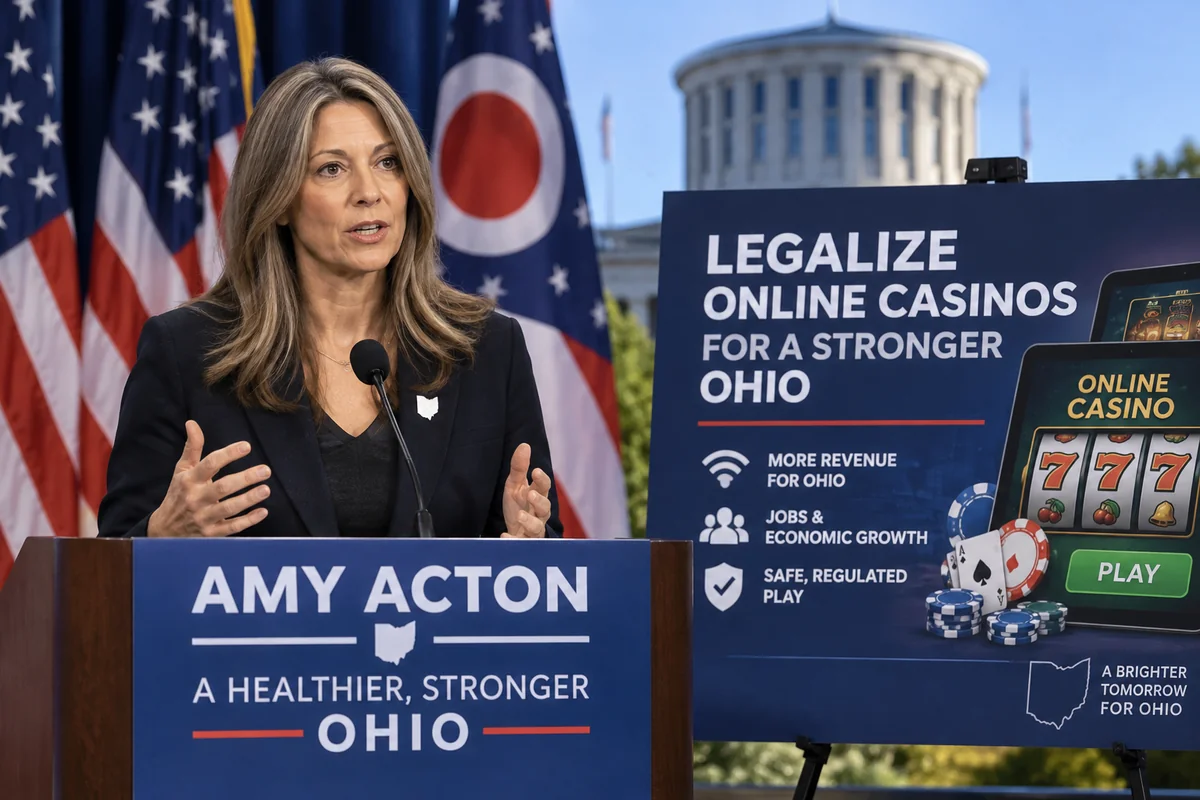
Illustrative AI-generated image, not a photo of a real event.