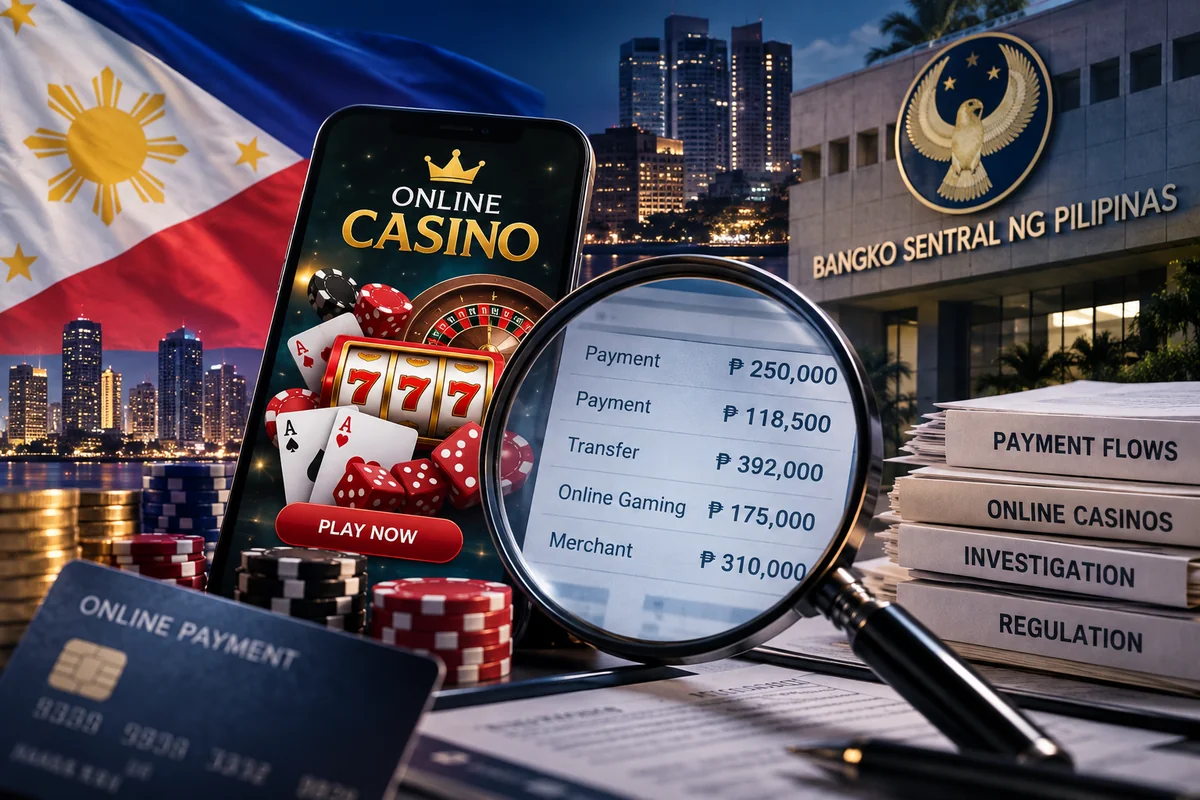
The Philippines' central bank is preparing tougher rules for payment service providers after its surveillance uncovered thousands of merchant accounts — registered to salons, bakeries and neighbourhood stores — that were allegedly being used to funnel wagers to illegal online casinos.
Key takeaways
- More than 8,000 merchant accounts have been closed over alleged illegal online casino transactions
- Suspicious accounts processed thousands of late-night payments, some as small as PHP50 (about $0.80)
- A BSP draft circular would require ownership and licence data on merchants and restrict layered payment structures
- Casino and wagering merchants would need direct arrangements plus enhanced due diligence — repeat failures could cost providers their licence
- GCash, Maya and the EMoney Association of the Philippines back the plan
Ordinary Shopfronts, Unusual Traffic
As first reported by Bloomberg, monitoring by the Bangko Sentral ng Pilipinas (BSP) flagged businesses that looked like everyday merchants on paper but were handling heavy volumes of tiny payments in the middle of the night. On closer inspection, regulators concluded that a portion of those transactions were in fact bets placed with online casinos.
The business identities involved included beauty salons, bakeries and small local shops. Since the findings, more than 8,000 merchant accounts have been shut down over alleged illegal activity.
Mamerto Tangonan, BSP Deputy Governor, said payment providers must do a far better job of vetting the businesses that operate on their platforms.
"We want to protect consumers from online fraud, illegal activities and also from money launderers. You cannot expand digitalization if people's money is being stolen or they're being scammed."
— Mamerto Tangonan, Deputy Governor, BSP
How Small Payments Gave the Game Away
The red flags emerged when some merchants were seen receiving thousands of transactions after midnight and into the early hours, with individual amounts as low as PHP50. That pattern made little sense for the kind of businesses named on the accounts, and further analysis traced the money to online casino betting.
Alejandro Tengco, Chairman and CEO of the Philippine Amusement and Gaming Corp. (PAGCOR), said the regulator is aware that some innocuously named businesses are really unregistered online casino operators — but acknowledged its limits: "Unfortunately, we don't have control over that."
PAGCOR is coordinating with the BSP on the problem and is also developing an app to help players verify legitimate online gaming sites, which it expects to launch before the end of 2026.
The case has also put a spotlight on merchant aggregators — intermediaries that plug businesses into payment channels. They help payment companies reach smaller merchants who might otherwise struggle to access formal financial services, but they can also obscure who is actually being paid. The BSP's proposals aim to give clearer sight of both the receiving merchants and their ultimate owners.
What the Draft Rules Would Change
The central bank has circulated a draft setting out amendments to its payment-system regulations. Under the proposal, payment service providers would need to:
- Collect more detailed merchant information, including ownership details and relevant licences
- Maintain databases of legitimate merchants
- Limit payment set-ups that make it hard to identify the real merchant, beneficiary or settlement account
- Onboard casino and wagering businesses — online operators included — through direct merchant arrangements rather than chains of intermediaries
- Apply enhanced due diligence and monitoring to those gambling merchants
Providers that repeatedly fall short could ultimately see their payment licence put at risk.
"If there are illegal activities and you're not able to stop it, then you are accountable."
— Mamerto Tangonan, Deputy Governor, BSP
The move builds on earlier BSP intervention in gambling payments. In 2025, the central bank ordered e-wallet providers to strip out direct links to licensed online gaming operators. PAGCOR has since put the share of Philippine online gambling flowing through licensed operators at roughly 50%, while industry reports have cited a figure as high as 75% before those e-wallet links were removed.
E-Wallet Giants Sign On
The country's biggest payment players have welcomed the tighter controls. Maya said it supports measures that "strengthen the integrity, safety and trustworthiness of the digital payments ecosystem," adding that it already runs merchant onboarding, due diligence and monitoring processes.
GCash likewise backed the BSP initiative, saying it remains "committed to working closely with regulators and industry partners toward a safer, more trusted, and inclusive digital economy for all Filipinos."
The EMoney Association of the Philippines also voiced support and said it is reviewing the proposed circular.
"It is important that there is accountability from the industry to ensure that we have a safe digital ecosystem for the market."
— Representative, EMoney Association of the Philippines
Digital Payments Boom Raises the Stakes
| ~10% E-payment share of retail transactions, 2018 |
57% Share in 2024 |
~2/3 Share in 2025 |
The crackdown lands as electronic payments take over Philippine retail. They accounted for roughly two-thirds of retail transactions in 2025, up from 57% in 2024 and around 10% in 2018, when the BSP started publishing the data.
Tangonan conceded that stricter merchant vetting could slow the rollout of digital payment services in the short term, but argued the controls will underpin healthier growth over the long run.
"You shouldn't sacrifice safety for growth. There's no trade-off there."
— Mamerto Tangonan, Deputy Governor, BSP