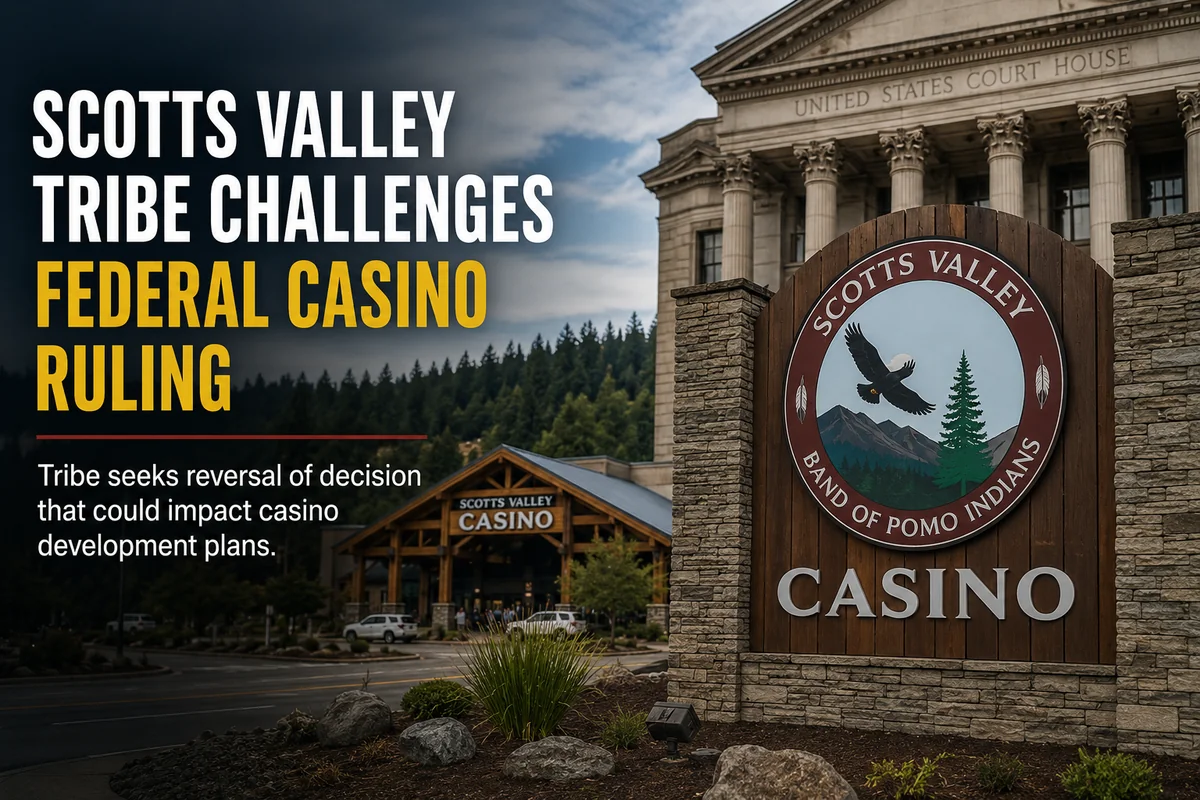
The Scotts Valley Band of Pomo Indians has taken the U.S. Department of the Interior back to court, fighting to rescue a $700 million casino development in Vallejo, California after federal officials ruled the site ineligible for gaming — a decision that shuttered the tribe's preview casino just seven days after it opened.
Key takeaways
- Lawsuit filed 7 August in the U.S. District Court for the District of Columbia.
- Target: Interior's 30 July finding that the Vallejo site fails IGRA's restored-lands test.
- The temporary casino opened 24 July and closed 31 July — seven days of trading.
- The wider project covers roughly 160 acres and an eight-story casino resort.
- The tribe says it sank more than $10 million into the preview facility alone.
- Four other tribes have separate suits pending against the January 2025 approval.
The complaint asks the court to vacate a 30 July determination by the Interior Department holding that the Vallejo property does not qualify for gaming under the Indian Gaming Regulatory Act (IGRA). Alongside it, the tribe is pressing for a preliminary injunction that would let the temporary gaming floor reopen while the litigation runs its course.
At stake is a development planned across roughly 160 acres near Interstate 80 and Columbus Parkway. The blueprint runs to an eight-story casino, restaurants, bars, a ballroom, a parking structure, tribal government offices, housing and a 45-acre biological preserve.
The modular preview facility built near the site took its first customers on 24 July and stopped trading on 31 July, a day after the department formally issued its ruling.
The venue at 200 Columbus Parkway opened to invited guests only, running a limited number of Class II gaming machines inside repurposed modular buildings. It rested on a memorandum of understanding approved by the Vallejo City Council in April 2026, under which the tribe agreed to pay the city $402,000 a year for public safety and administrative costs plus a $100,000 activation fee.
A decade-long fight returns to the courtroom
The filing is the latest turn in a dispute running back nearly ten years. The Scotts Valley Band first applied for restored-lands gaming eligibility in 2016, backing the request with more than 4,000 pages of historical, genealogical and anthropological material. Federal officials rejected it in 2019.
In 2022 the same D.C. district court called that denial arbitrary and capricious, ordering Interior to reassess the application through the Indian canon of construction and IGRA's remedial purposes. The department duly reversed course and approved gaming eligibility for the Vallejo site in January 2025.
The approval was short-lived. The Trump administration rescinded it in March 2025; a federal court subsequently found the rescission had violated the tribe's due process rights and reinstated the eligibility decision, while leaving the door open for federal reconsideration. That reconsideration wrapped in July 2026 with the department once again concluding the property does not qualify.
The January 2025 decision, dated 10 January in the closing days of the Biden administration, had taken the parcel into trust for gaming, government use and housing. Interior withdrew the gaming determination on 27 March 2025 after neighbouring tribes argued their evidence had not been considered. On 30 October 2025, U.S. District Judge Trevor McFadden vacated that rescission because the band had not been given adequate notice or a meaningful chance to respond, writing that it "learned of the rescission only once it was a fait accompli." He let the review continue, with a final decision due by the end of July 2026.
Assistant Secretary for Indian Affairs William H. Kirkland III found the site did not meet the federal exception covering gaming on restored tribal lands, ruling that the band had not shown the significant historical connection to the Vallejo parcel the framework requires.
"Consequently, the Vallejo parcel does not qualify as restored lands within the meaning of applicable law, and the Band may not conduct gaming on the parcel pursuant to (Indian Gaming Regulatory Act's) restored lands exception. I provide no opinion on whether the Band may game on the parcel pursuant to another exception."
— William H. Kirkland III, Assistant Secretary for Indian Affairs, July 2026 decision
Kirkland, a Navajo Nation citizen, was confirmed by the U.S. Senate as assistant secretary on 7 October 2025. Tribal Chairman Shawn Davis responded that the administrative record "overwhelmingly supports the Tribe's gaming eligibility."
The tribe's case: old errors, repeated
The band's core argument is that the July decision reruns reasoning the courts have already struck down. The lawsuit characterises the determination as follows:
"Arbitrary, capricious, contrary to law, unsupported by the administrative record."
— Scotts Valley Band of Pomo Indians, complaint filed 7 August
According to the complaint, officials leaned on an analytical framework close to the one the court rejected in 2022 rather than the guidance set out in that earlier litigation. The filing also singles out language in the July decision implying that the tribe would have fared better had its people not been so widely scattered through history — reasoning the band says turns missionization, disease, forced labour and dispossession into evidence against its claim, when those are precisely the historical circumstances the record should account for.
A second flashpoint is the Royce Area 296 map, a 19th-century federal document charting territory ceded under an 1851 treaty signed by the tribe's ancestors. The Vallejo property sits inside that boundary. The complaint notes that Interior itself relied on the map in earlier Scotts Valley land assessments, including a 2012 determination and the January 2025 approval, and argues the department cannot now brush aside evidence it previously treated as material.
The band's earlier Bay Area bid, a casino complex proposed in 2004 for North Richmond, was rejected by Interior in 2012 after the department concluded the Lake County-based tribe lacked a significant historical connection to that site, the same test it has now applied in Vallejo.
What the shutdown cost
Court filings put numbers on the fallout. The tribe says it spent more than $10 million standing up the preview casino. It also formed a Tribal Gaming Commission, secured National Indian Gaming Commission approval of its gaming ordinance, and hired nine staff — all tribal members, trained at a Nevada casino ahead of the opening.
Agreements with the City of Vallejo covering public safety services and utility connections were signed in anticipation of gaming. The closure, per the complaint, has cut off the payments the city was expecting, left employees facing furlough, and disrupted compact negotiations with the State of California.
Named as defendants are Interior Secretary Douglas Burgum, Assistant Secretary Kirkland and the department itself. The tribe wants the 30 July determination invalidated, the January 2025 eligibility decision restored, and the preview casino permitted to reopen pending the outcome.
Complicating matters, separate challenges to that January 2025 approval — brought by the Yocha Dehe Wintun Nation, United Auburn Indian Community, Lytton Rancheria and Kletsel Dehe Wintun Nation — are still live and could pick back up now that the federal reconsideration has concluded. For the moment the Vallejo project stays in limbo while the courts revisit, once more, how the restored-lands standard should be applied.
Why rival tribes are fighting the project
IGRA, passed in 1988, generally bars gaming on land taken into trust after that year; the restored-lands exception is the route tribes such as Scotts Valley have used to pursue sites far from their current reservations.
The Yocha Dehe Wintun Nation, which runs Cache Creek Casino Resort, argues that Vallejo lies within Patwin ancestral territory rather than Pomo land. "Vallejo is Patwin territory, and it always has been," Chairman Anthony Roberts said in July 2025. On 28 May 2026 the nation also sued the City of Vallejo in Solano County Superior Court, alleging the council approved the preview casino agreements without the environmental review required by California law.