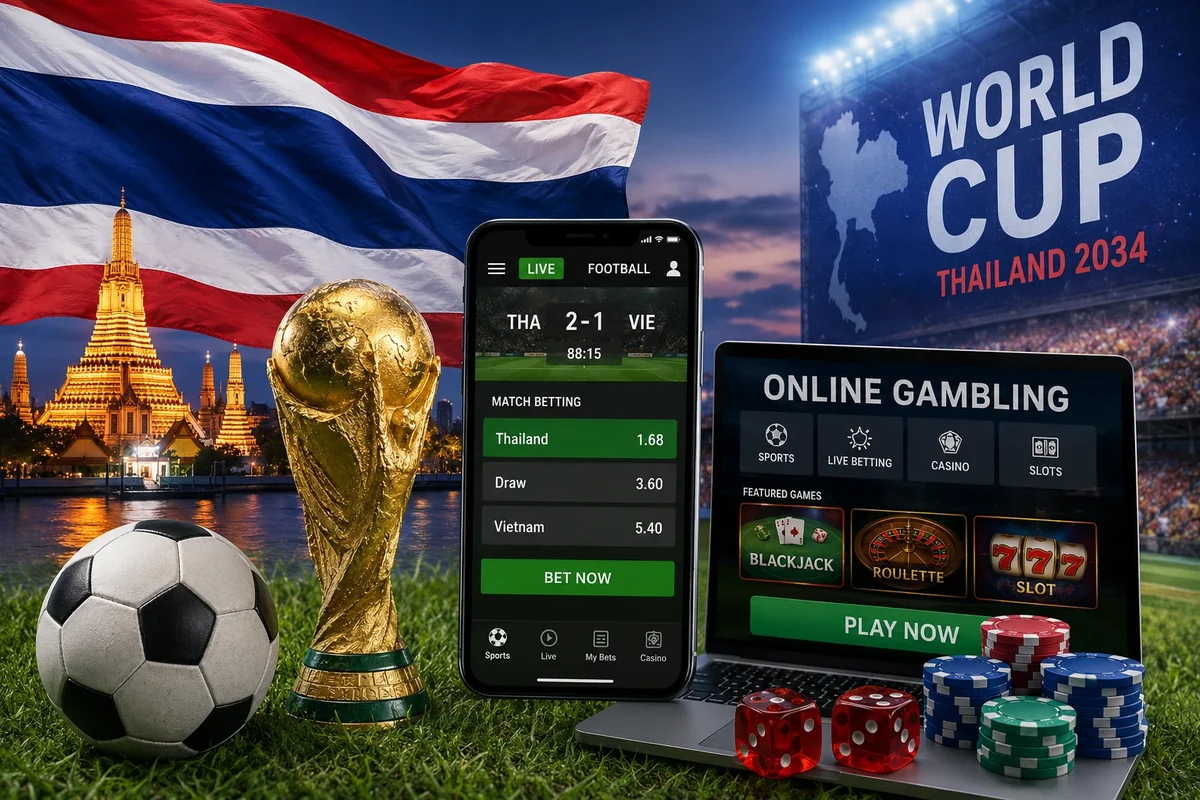
Thailand has stepped up its campaign against online gambling in the run-up to the FIFA World Cup, with police blocking hundreds of thousands of betting-related links and warning that millions of young people are being pulled into the activity.
Key takeaways
- 717,425 gambling-related links were blocked between 1 October 2025 and 20 May 2026, including on Facebook, Line and TikTok.
- Police say more than 4 million Thais aged roughly 15 to 25 have been drawn into online gambling.
- 309 gambling websites were earmarked for action in May and June, with AI used to speed up detection.
- Networks are moving money through corporate accounts, PayPal, cross-border intermediaries and crypto, and marketing through influencers.
- Gambling remains almost entirely illegal in Thailand after the casino legalisation bill was dropped in 2025.
The country's National Police Chief, Police General Kittirat Phanphet, has ordered all relevant units to take decisive action against every form of online betting, deploying the full range of tools available — from investigations to continuous site takedowns and the blocking of social media channels.
Between 1 October 2025 and 20 May 2026, authorities removed access to 717,425 links across websites and platforms including Facebook, Line and TikTok.
The timing is deliberate. The 2026 World Cup, co-hosted by the United States, Canada and Mexico, is scheduled to run from 11 June to 19 July and will be the first edition with 48 teams — meaning more matches, and more betting opportunities, than any previous tournament.
Youth Involvement Drives the Crackdown
Officials say the scale of the problem among young people is a central reason for the tougher stance. According to police, more than 4 million Generation Z youths — many aged between 15 and 25 — have become involved in online gambling in just six months, even as enforcement has tightened.
The estimate comes from statistics and analysis compiled by the police's Information Technology Crime Suppression Centre, which found that a large share of those young players were new to gambling. Police Lieutenant General Trairong Phiwpan, a deputy inspector-general who also serves as the centre's deputy director, has been setting out the results of the crackdown. The same unit has been told by the national police chief to monitor young people specifically during the tournament and to intensify action against online football betting on every platform.
With the World Cup expected to fuel a surge in football betting, shielding minors and young adults from gambling-related harm has become a stated priority for the force.
AI and Targeted Operations
The Technology Crime Suppression Division (TCSD), led by Police General Thana Chuwong, is focusing on the operators behind gambling sites. A total of 309 gambling websites have been earmarked for review and shutdown during May and June 2026.
Police are also turning to artificial intelligence to detect gambling-related content more quickly and accurately, allowing faster blocking of offending sites and accounts. Authorities confirmed that arrests have already been made, with more expected to follow.
"Police General Kittirat Phanphet, the National Police Chief, has instructed all concerned units to take decisive measures against online gambling by making full use of all possible means, ranging from investigation to continuous crackdowns and blocking of websites and social media channels,"
— said Police Lieutenant General Trairong Phiwpan
Operators Shift Their Tactics
Investigators note that gambling networks have grown more sophisticated in how they move money. Operators have moved away from traditional "mule" accounts toward corporate accounts, PayPal, cross-border intermediaries and cryptocurrency to process payments and evade detection.
Promotion has become more covert too. Gambling brands are increasingly marketed through influencers, live streams and short-form videos, often targeting economically vulnerable audiences with promises of fast and easy money.
The Royal Thai Police warned that both those running gambling operations and the influencers who promote them face serious legal consequences.
Trairong went further, urging people to stop creating gambling content, sharing links or otherwise encouraging others to bet, and warning that anyone who continues will face strict legal action.
Influencer promotion has been on the police radar for some time. In November 2025, Thai authorities opened an investigation into the Miss Universe 2025 pageant after allegations that contestants had promoted online casinos while staying in the country, an activity that is illegal under Thai law.
What Parents Are Told to Watch For
Health officials have been pushing a prevention message alongside the policing. The Rajanukul Institute, part of the Department of Mental Health at the Ministry of Public Health, has pointed out that gambling addiction is classed as a mental health disorder under American psychiatric diagnostic criteria. Its guidance lists behavioural red flags such as lying, borrowing money, skipping school, slipping grades and growing isolation, along with sharp mood swings between wins and losses.
The institute advises families to restrict website access, keep credit cards out of children's reach, check payment slips regularly, put computers in shared rooms, set clear internet rules and talk openly with children about gambling.
A Long Fight Against Football Betting
Thailand's legal position is strict. Under the Gambling Act of 1935, almost all gambling is banned, with exceptions only for horse racing and the government-run lottery, and online gambling is illegal. Since 2020 the Ministry of Digital Economy and Society has worked with other state agencies to block gambling websites.
Major football tournaments have repeatedly triggered special enforcement. During the 2010 World Cup, more than 1,700 people were arrested for gambling offences. For the 2022 World Cup in Qatar, the Royal Thai Police set up a dedicated task force supervised by then deputy national police chief Torsak Sukvimol, with undercover officers watching game rooms and internet parlours.
Cross-border cooperation has grown as well. Thailand was one of 28 countries and territories in Interpol's Operation SOGA X, run during Euro 2024 in June and July that year. Thai police raided two locations hosting major illegal betting websites, arrested the ringleaders on gambling and money-laundering charges and seized assets worth more than US$9 million; across all participants, the operation produced over 5,100 arrests. Separately, in August 2024, three Chinese nationals were arrested in Thailand for running an illegal online casino with turnover above 5.5 billion baht.
Legalisation Off the Table for Now
An alternative approach — regulating gambling rather than only policing it — has stalled. The cabinet approved a draft Entertainment Complex Bill in January 2025 that would have allowed casinos inside large integrated resorts, but in July 2025 the House of Representatives voted 253 to 65 to remove it from the agenda. In September 2025 a special Senate committee formally rejected the draft, citing social, economic and national security concerns, and recommended that any future attempt be put to a public referendum. That leaves blocking, arrests and awareness campaigns as the state's main tools heading into the tournament.
Looking for a licensed, safe place to play? Play at Mr Jones Casino and get started today.