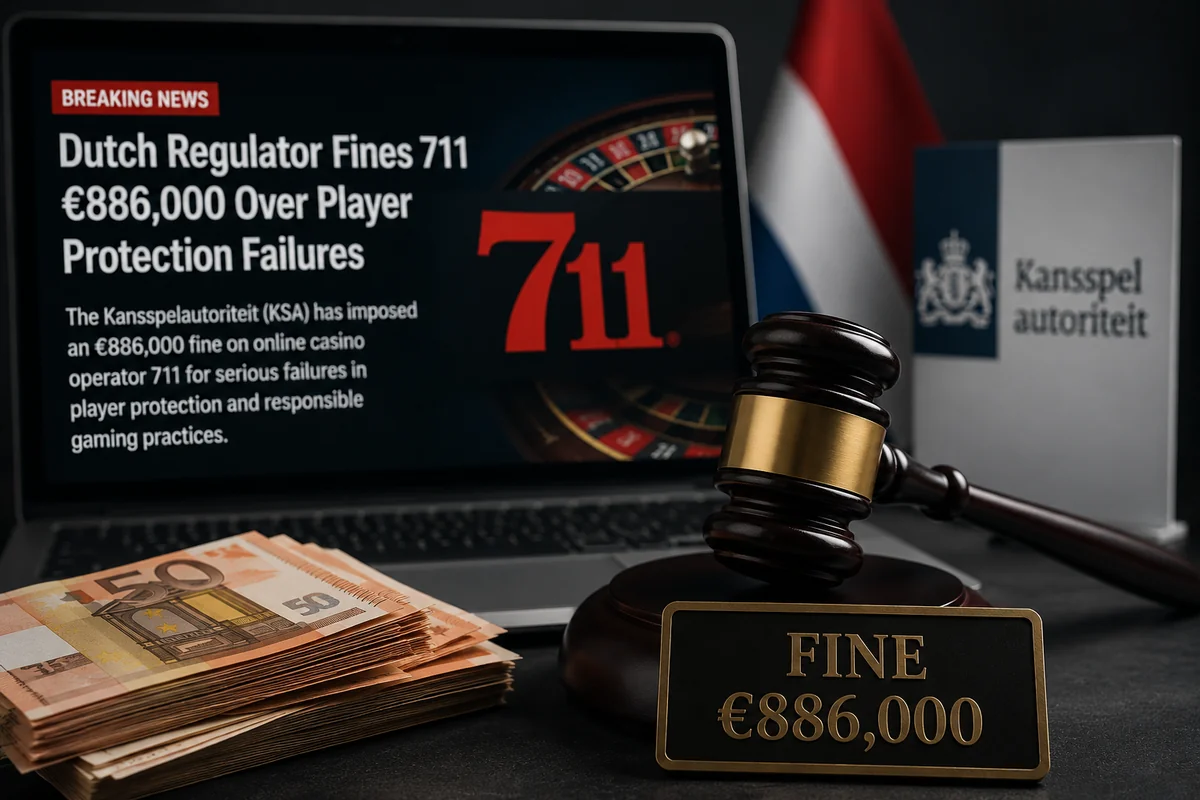
The Dutch gambling regulator has hit online operator 711 with an €886,000 fine, ruling that the company repeatedly failed in its duty of care to players over more than two years — in one case letting a customer lose €27,000 in just four days.
Key takeaways
- The KSA fined 711 B.V. €886,000 for duty-of-care failures between February 2022 and June 2024.
- All ten high-risk customer files the regulator reviewed contained violations.
- One player lost €27,000 in four days — more than ten median monthly salaries.
- The KSA signalled that further duty-of-care fines are likely to follow.
The penalty was handed down by the Kansspelautoriteit (KSA) after an investigation into whether 711 properly monitored and responded to signs of harmful gambling. The regulator found the failures ran from February 2022 to 26 June 2024 and affected players showing classic indicators of elevated risk. It is part of a wider review of how licensed operators have applied responsible-gambling rules since the Dutch market opened in October 2021 — and the KSA has made clear more enforcement is coming.
The operator and the case timeline
711 B.V. is a company registered in Jabbeke, Belgium, that serves Dutch customers through 711.nl with online sports betting and casino games. According to the sanction decision, its Dutch remote gambling licence runs until 15 March 2027. The ten files were picked from the KSA's control database, covering the players who lost most with 711 between October 2023 and March 2024. Inspectors finished their report on 16 January 2025, 711 answered in writing that April and at a hearing on 17 April 2025, and the board signed the decision on 26 May 2026. The operator can still lodge an objection.
Ten high-risk files, ten violations
To test compliance, the KSA pulled ten customer files belonging to players who had recorded heavy losses, gambled on many separate days, or routinely placed bets during the night. Every single one, the regulator said, contained breaches.
According to the findings, 711 failed to properly analyse player behaviour and did not step in when warning signs appeared, allowing activity to escalate unchecked and exposing some customers to serious financial losses. The regulator also concluded the operator did not consistently follow its own responsible-gambling procedures — including an internal policy that was supposed to trigger a risk assessment whenever a customer lost €2,500. Where those reviews were warranted, the KSA found, they were frequently carried out far too late.
The decision notes that 711's policy also applied the €2,500 trigger to deposits. Its software analysed play automatically, but the KSA concluded that this model spotted risk too late or not at all, and that the operator let extreme play continue for weeks, sometimes months, without a fitting response. The operator let customers set deposit limits of up to €25,000 a day, €50,000 a week and €100,000 a month, which the KSA said robbed those limits of any protective value. One player lost almost €78,000 on a single day in 2023, and net deposits across the ten files totalled €889,045.
€27,000 lost in four days
The regulator put particular weight on the scale of the losses, repeatedly measuring them against median incomes in the Netherlands. In one cited case, a player lost €27,000 in four days — equivalent to more than ten median monthly salaries — while holding a daily deposit limit worth over seven median monthly salaries.
“It is also important in this regard that the player lost an amount exceeding 10 median monthly salaries in four days and had a daily deposit limit of more than seven median monthly salaries, while 711 had no insight whatsoever into the player’s financial position.”
— Kansspelautoriteit (KSA)
In such circumstances, the authority concluded, far stronger intervention was needed to prevent excessive play and reduce the risk of addiction-related harm.
That customer had opened an account in 2023, quickly hit a €19,000 daily deposit cap and raised it to €20,000. 711 replied with a responsible-gambling email and a 30-day bonus block. A big win followed and he withdrew more than €90,000, then excluded himself and came back more than once. 711's reviews repeatedly found no action was needed, in effect only noting that he was ahead overall; by the time he joined the national exclusion register Cruks in 2024, nearly all of the winnings were gone. A net profit, the KSA said, does not justify ignoring other warning signs.
How the KSA reached €886,000
The standard route — a €500,000 base amount plus 25% for aggravated culpability, or €625,000 — was judged too weak. 711 had reported gross gaming revenue of €67,393,283 for 2025, so the KSA switched to a revenue-based fine of 1.25% of that figure, or €842,416. It then raised the sum to €889,000, matching the ten players' rounded net deposits, and deducted €2,500 because the procedure had run three months beyond a reasonable time, which after rounding left €886,000. 711's request for a reduction over limited ability to pay was rejected after the company declined, in March 2026, to supply the remaining financial data.
711's defence and a 2022 warning
711 argued, among other things, that its prediction model looks at changes in behaviour rather than single incidents, and that the KSA was applying standards retroactively. The regulator disagreed, pointing out that operators had been warned in public years earlier, including by then-chairman René Jansen at the Gaming in Holland conference on 20 June 2022.
“Such a signal is, for example, a player who can bet a lot with high stakes without hindrance. An argument like ‘I can't look into the player's wallet’ is not enough as we all understand that the vast majority of Dutch players cannot afford to lose so much money.”
— René Jansen, then Chairman, KSA (June 2022)
Part of a wider KSA crackdown
KSA Chairman Michel Groothuizen tied the fine to broader concerns about how operators rolled out player-protection controls after the market was liberalised.
“We have observed that not all providers implemented their duty of care equally well from the opening of the market. We have therefore conducted additional investigations, which are now resulting in various duty of care fines. At the same time, we have further tightened the requirements regarding the duty of care to prevent excesses such as those we are seeing here in the future.”
— Michel Groothuizen, Chairman, KSA
Those investigations have already produced a string of penalties: Betcity operator Betent was fined €2,650,000 in October 2025, Unibet operator Optdeck €4,000,000 in December 2025, LeoVegas €500,000 later that month and ComeOn operator Tulipa Ent €750,000 in January 2026. In March 2026 the KSA also issued guidance on personal interviews with at-risk players and on Cruks notifications.
The action caps a busy year for the regulator. In March, it issued a record fine of around €25 million to Novatech over alleged illegal operations aimed at Dutch consumers, while prediction-market platform Polymarket was also sanctioned for operating without a local licence. The KSA continues to insist that licensed operators must actively watch customer behaviour and act on warning signs — through behavioural analysis, direct intervention, account restrictions and, where needed, exclusion.
A separate warning for TOTO
The 711 case wasn't the regulator's only recent move. The KSA also warned Nederlandse Loterij-owned TOTO Online over marketing tied to professional football clubs — social-media promotions that invited customers to place a €5 bet for the chance to win signed club shirts. Dutch rules ban the use of role models in gambling advertising, a safeguard aimed at limiting gambling's appeal to younger audiences.
That episode has reignited debate over youth protection. Christian Democratic Appeal politician Meryam Sümer has called for the minimum gambling age to rise from 18 to 24, arguing tougher safeguards are needed to cut young people's exposure to gambling risk. At the time of the announcement, 711 had not publicly responded to the penalty.