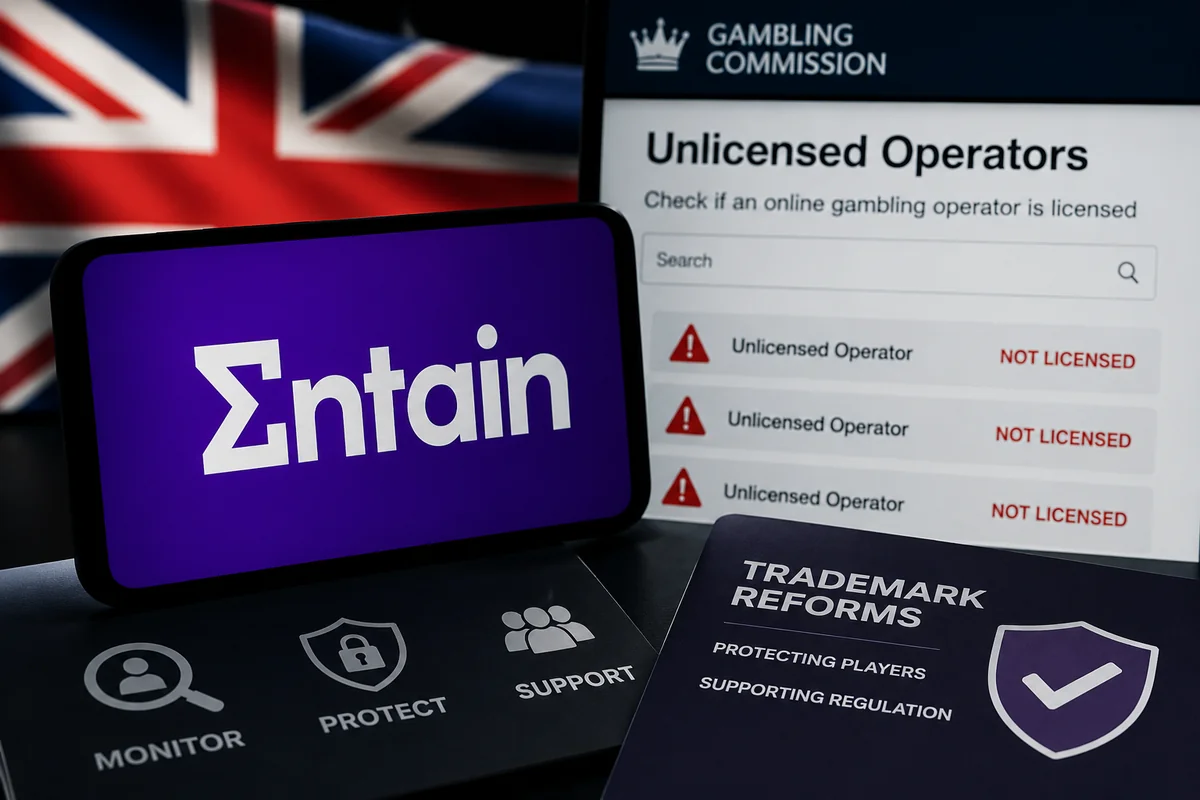
Entain, the London-listed gambling group, has stepped up its drive against unlicensed and illegal gaming in the UK — this time training its sights on trademark protection. The FTSE 250 operator has formally flagged its concerns to the UK Intellectual Property Office (UKIPO), calling for tighter scrutiny of gambling brands applying for British trademarks.
Key takeaways
- Entain wants the UKIPO to require proof of a Gambling Commission licence before registering gambling trademarks.
- It argues unlicensed operators — many based in Curaçao or Anjouan — gain undue “commercial legitimacy” through UK marks.
- The UKIPO has so far rejected making prior regulatory approval a condition of registration.
- The campaign extends to sport, with Entain lobbying the Premier League and the IFR to deal only with licensed operators.
- Of 18 brands Entain believed were serving UK customers without a licence, it found 14 holding UK trademarks.
Entain’s core argument is that the current framework lets unlicensed companies secure trademarks, handing them what it calls “the commercial legitimacy that registration confers” even though their operations are illegal under UK law.
“[Entain] has been around for some time now and we’re on a journey of trying to create more and more awareness about the harm of black-market gambling operators. Increasingly, there is more and more market share being lost to these kinds of companies in the UK.”
— Simon Zinger, Group General Counsel & Chief Customer Care Officer, Entain
The operator has filed an annex naming unlicensed firms that already hold UK trademarks, pointing out that many are registered in jurisdictions such as Curaçao or Anjouan. Entain contends that the UKIPO should weigh an applicant’s regulatory status and the intended use of a mark, rather than assessing the mark in isolation. Beth Williams, the group’s head of IP, said the regulator could look at mechanisms to ensure only licensed operators gain commercial legitimacy through trademarks.
What Entain found on the register
The concerns were set out in a letter from Zinger addressed to Adam Williams, who has led the IPO as chief executive and comptroller general since December 2022, having served as interim head from September that year. Entain’s own review covered 18 brands that, in its view, were accepting UK players while lacking a Gambling Commission operating licence; 14 of those unlicensed names turned out to own UK trademark registrations. Several examples were listed by name in the letter, including some brands said to have Russian ties.
“The UK’s intellectual property system is rightly regarded as one of the best in the world. It would be a significant anomaly if that system continued, inadvertently, to extend its protections to operators who have placed themselves outside the law that governs the sector in which they operate.”
— Simon Zinger, Group General Counsel & Chief Customer Care Officer, Entain
Calls for proof of licensing
Entain stresses that offering gambling services in Great Britain without a licence is a criminal offence under Section 33 of the Gambling Act 2005. It has proposed that the UKIPO require evidence of a valid Gambling Commission licence before registering any gambling-related trademark. Zinger also suggested aligning the approach with the Companies Act 2006, which bars unregulated companies from registering names implying a regulated service, such as “bank” or “insurance.”
On summary conviction, anyone who provides gambling facilities without an operating licence, or outside the terms of one, faces up to 51 weeks in prison (six months in Scotland), a fine of up to level 5 on the standard scale, or both. The company-name comparison is also concrete: Companies House treats words such as “bank” as sensitive, and anyone wanting to use one in a company name must first produce a letter or email of non-objection from the Financial Conduct Authority.
To bolster its case, Entain has asked the Gambling Commission to set up a proactive objection process during the two-month trademark publication window, so unlicensed operators cannot quietly gain legitimacy. UKIPO chief executive and comptroller general Adam Williams acknowledged that trademark law allows objections where registration is prohibited by law, but rejected the idea that prior regulatory approval should be a precondition.
“The assessment of whether a mark is contrary to public policy, or whether its registration is prohibited in law, relates to the intrinsic properties of the mark itself. This does not involve an assessment of the actions of the applicant or how the mark is used.”
— Adam Williams, Chief Executive and Comptroller General, UKIPO
How the IPO sees its remit
Williams’ position mirrors the structure of the Trade Marks Act 1994. Its absolute grounds for refusal in section 3 block marks that are contrary to public policy or accepted morality, marks likely to deceive the public, and marks whose use is prohibited in the UK by another law, as well as applications made in bad faith. The public-policy and prohibited-use tests are applied to the sign being registered, which is why the office argues it cannot vet the lawfulness of the business behind it.
That two-month window is the journal period: once an application clears examination, the IPO publishes it and anyone may lodge an opposition before the mark is registered.
In its 2 June response, the IPO told Entain that officials handling trademark policy now had the file and that the two sides would meet to talk it through. Williams added that trademarks have nothing like the Companies House gatekeeping on sensitive company names, while pointing out that UK sanctions, Russia-related measures among them, already reach IP rights.
A wider anti-black-market push
The campaign reaches beyond trademarks. Entain has lobbied sporting bodies — including the Premier League and the Independent Football Regulator (IFR) — to ensure clubs partner only with licensed operators. Its Ladbrokes brand is a partner of Liverpool FC, and the group has encouraged other Premier League sides to adopt the same stance.
In an open letter to Premier League chief executive Richard Masters in February, Entain CEO Stella David asked for pitchside LED advertising by unlicensed bookmakers to be halted at once and for such brands to be removed from match and training kit from the 2026/27 season. It followed a government announcement of a consultation on barring unlicensed operators from secondary sponsorship slots such as sleeves, and clubs had already agreed to drop front-of-shirt betting sponsors from that season. To underline the scale, Entain pointed to research putting annual UK online stakes with unregulated operators at £2.7bn, with the illegal market said to have grown more than fourfold since 2022.
In May the group took the argument to the IFR’s second licensing consultation. It noted that Everton (Stake), Sunderland (W88), Fulham (SBOTOP), Bournemouth (bj88) and Burnley (96.com) carried shirt deals with operators not licensed in Britain, and that 18 of the 20 top-flight clubs had shown unlawful operators on LED boards during the season. Because the regulator’s draft rules already stop clubs taking money tied to serious crime, Entain wanted guidance spelling out that revenue from unlicensed betting firms falls into that category.
“Premier League clubs are being sponsored by criminal gambling firms. The Independent Football Regulator can stop this tomorrow by simply acknowledging that unlicensed gambling companies targeting UK customers through English football are breaking the law – plain and simple.”
— Stella David, Chief Executive, Entain
Leadership changes at the regulators
The lobbying comes during a period of upheaval in UK gambling oversight. The Gambling Commission currently has no permanent CEO, while the Department for Culture, Media and Sport (DCMS) has recently appointed Emma Floyd as director of sport and gambling. Until those leadership posts settle, Entain may need to keep pressing its case largely on its own.
Floyd announced her appointment on LinkedIn on 8 June, taking over from Ben Dean, who moved to a Cabinet role earlier in 2026.
By going after unlicensed operators through both trademark policy and sports partnerships, Entain aims to curb the black market’s influence and keep UK gambling activity within legal and consumer-protection boundaries.