After more than 15 years of waiting on a decision, the Little River Band of Ottawa Indians is no longer holding its Fruitport Township land in reserve — the tribe has started planning alternative development on the 170 acres that sit outside its stalled Muskegon County casino footprint.
Key takeaways
- The tribe holds roughly 230 acres on Harvey Street: 60 in trust for the casino, 170 outside it.
- The proposed venue would pair a 70,000 sq ft gaming floor with a 220-room hotel.
- Gov. Gretchen Whitmer declined to back the project in 2022 and has not given a definitive answer since.
- Around $35 million has already been spent pursuing approval; build costs have climbed toward $300 million.
- Supporters project 1,500–3,000 jobs and about $10 million a year in state revenue.
The land in question sits near where I-96 meets U.S. 31, on the site of the former Great Lakes Downs Racecourse. Almost twenty years after the track shut its doors, most of the parcel is still empty — not for lack of a plan, but because the plan has been stuck in a state and federal approval queue that refuses to resolve.
Great Lakes Downs was a five-eighths-mile thoroughbred oval, originally known as Muskegon Race Course, that hosted thoroughbred racing for several seasons after a major renovation in 1999. Magna International bought it in January 2000 and ran it until the track closed in November 2007. The facility was demolished in 2008, the same year the tribe bought its casino lot there.
Tribal Ogema Larry Romanelli laid out the split ownership plainly.
"We've been trying to have a casino for 15 years plus. We have that land over there in trust. We have 60 acres in trust, and then we have another 170 acres."
— Larry Romanelli, Tribal Ogema, Little River Band of Ottawa Indians
That distinction matters. Only the 60-acre portion is held in trust and earmarked for gaming. The remaining 170 acres carry no such restriction, which means the tribe can build on them without waiting for anyone's signature.
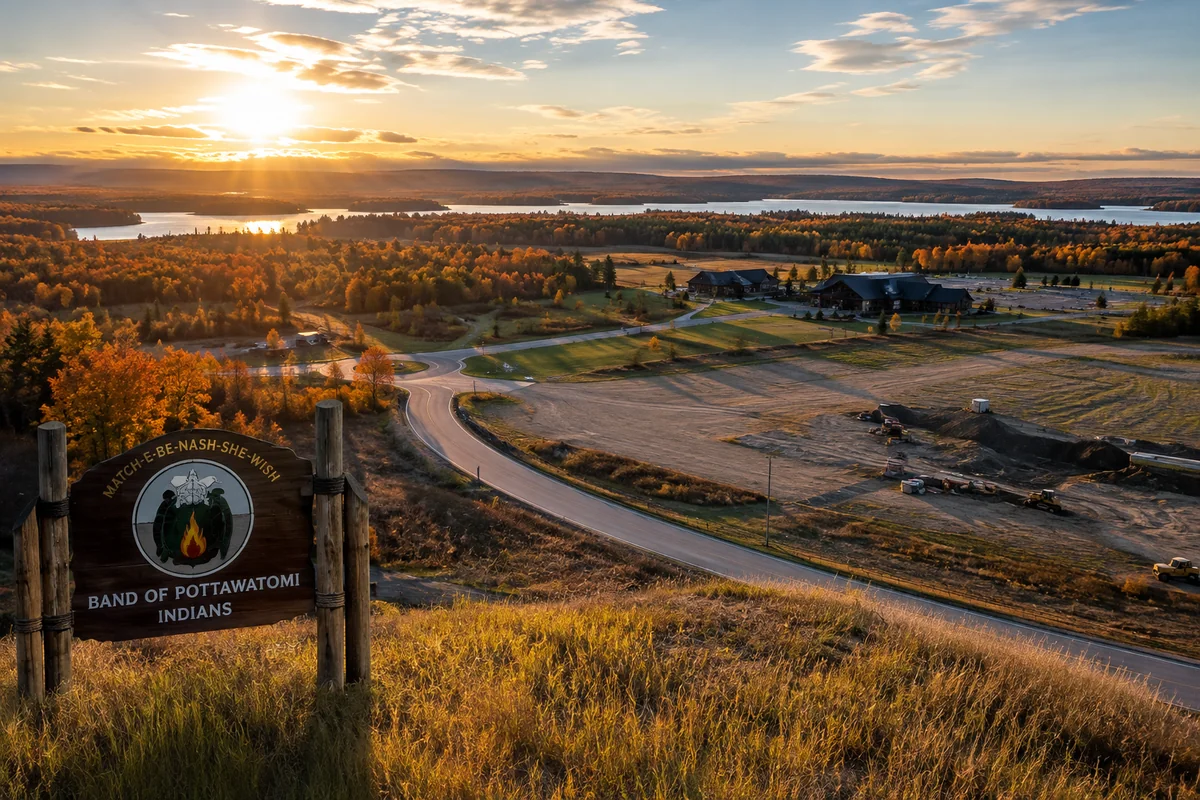
Attention Turns to the Surrounding Acreage
With the gaming question unresolved, tribal leadership has begun treating the larger parcel as a separate opportunity rather than a casino annex. Cleanup work is already underway.
"We're sitting on prime property right here. It would not be reasonable to keep this just vacant land."
— Larry Romanelli, via WZZM13
Nothing has been finalised, but the ideas floated so far span apartments, condominiums, office space and even a hospital. Developer Denny Cherette, whose firm has helped bankroll the project, framed the scale bluntly: "You know how much you can put on 170 acres? A lot of stuff," he said, pointing to rising housing demand in the area.
Romanelli added that the commercial corridor has effectively grown up to the tribe's doorstep. "Harvey Street has grown exponentially up to our property, and our property is probably the largest available to develop now, so we're at the crossroads here," he said.
A Casino Plan Frozen in Review
The proposed venue is substantial: a 70,000-square-foot gaming floor alongside a 220-room hotel. Because the site does not sit on existing tribal land, it needs clearance under the Indian Gaming Regulatory Act from both federal and state authorities before a single foundation can be poured.
The relevant clause, Section 20 of the 1988 law, generally bars gaming on land taken into trust after October 17, 1988. One exception is the so-called two-part determination: the Interior Secretary must find that a casino would serve the tribe and its members without harming the surrounding community, and the state's governor must then concur.
Parts of the federal review had already been cleared. The blockage came in 2022, when Gov. Gretchen Whitmer declined to endorse the project, tying her position to the federal recognition process involving the Grand River Bands of Ottawa Indians. The original submission subsequently lapsed, forcing the Little River Band to assemble and file updated materials at both levels of government.
The Interior Department had issued its favourable finding in December 2020. Whitmer's original deadline to respond was December 2021, which federal officials pushed back by six months at her request. When Interior declined to postpone it again, she issued her non-concurrence in mid-June 2022, writing to Interior Secretary Deb Haaland that the department had put her in an "impossible position". The neighbouring Grand River Bands had opposed the casino.
"Despite my best efforts to get answers from DOI with respect to the pending Grand River Bands' acknowledgment petition, I am left without information critical to my decision on the Little River Band's two-part determination."
— Gov. Gretchen Whitmer, letter to the Interior Department, June 2022
In the same letter she said she would "welcome the opportunity to revisit this question" once that petition was decided. Interior later turned down the Grand River Bands' recognition request, finding that the group had not met one of the seven mandatory acknowledgment criteria, after which the Little River Band signalled that it wanted to bring its casino proposal back to the governor.
For Romanelli, the absence of an answer has become a bigger problem than a negative one would be.
"I need a clear 'yes' or a clear 'no,' and to this date she still has not given it. I'm in a quandary here, because I have to develop the property."
— Larry Romanelli
By his account, conversations with the governor's office have never clarified whether the proposal was turned down or merely parked. He recalled being told in 2022 that the matter could be discussed once the situation with the other tribe became clearer — and, more recently, that she was "not willing to discuss this at this time."
The bill for that limbo is already considerable. The tribe has put roughly $35 million into pursuing the casino, and Fruitport Township has spent millions more on infrastructure laid down in anticipation of the development.
What the Community Stands to Gain — or Lose
Local officials have stayed firmly behind the plan on economic grounds. Fruitport Township Supervisor Todd Dunham pointed to the construction workforce alone: "If we can get this, it's going to bring in 3000 jobs, these are good union jobs building this casino and the other parts of the casino goes with this," he said. "It's frustrating."
Supporters put the employment estimate at somewhere between 1,500 and 3,000 positions, plus around $10 million a year flowing to state coffers. Inflation has not been kind to the budget, though — Romanelli now estimates the build at close to $300 million, against earlier projections of roughly $200 million.
Residents are less unified. Traffic and public safety worries sit on one side, the promise of entertainment and economic activity on the other. What most locals do agree on is that a parcel this size should not sit idle indefinitely, whatever eventually goes on it.
The Muskegon County site would be the band's second gaming property. The federally recognised tribe, based in Manistee and Mason counties, has run the Little River Casino Resort in Manistee since 1999, after Gov. John Engler signed its gaming compact in December 1998. When Whitmer said no in 2022, Romanelli noted the project had drawn backing from the Obama, Trump and Biden administrations and from former governors Jennifer Granholm and Rick Snyder.
Romanelli is still holding out for clarity, and the calendar may provide it: Gov. Whitmer's term ends on January 1, 2027. "I talked with some of the candidates early on, so we're listening and looking," he said. "We'll just have to see what goes on."
Whitmer cannot run for a third term. Michigan's August 4 primaries made Democratic Secretary of State Jocelyn Benson and Republican Congressman John James the major-party nominees for the November 3 election, with the tribe's request still waiting on the governor's desk.