On a rainy Thursday morning in May, a steady stream of cars filled a parking lot that straddles the Massachusetts–New Hampshire border. Engines idled as drivers waited for the clock to strike 9 a.m. — opening time at The Nash Casino.
When the doors finally unlocked, patrons flooded in beneath thumping pop music and flashing lights, drawn toward rows of vivid slot machines and gaming tables. Even at breakfast hour, the room felt less like a casino and more like a party in full swing.
The Nash is now the largest “charitable gaming” venue in New Hampshire — 130,000 square feet of gaming, dining and entertainment carved out of a former Sears at the Pheasant Lane Mall. When it opened in March 2025, more than 16,000 people turned up on day one.
“The debut was so busy the restaurants ran out of food,” recalled general manager Eric Althaus. “It was crazy.”
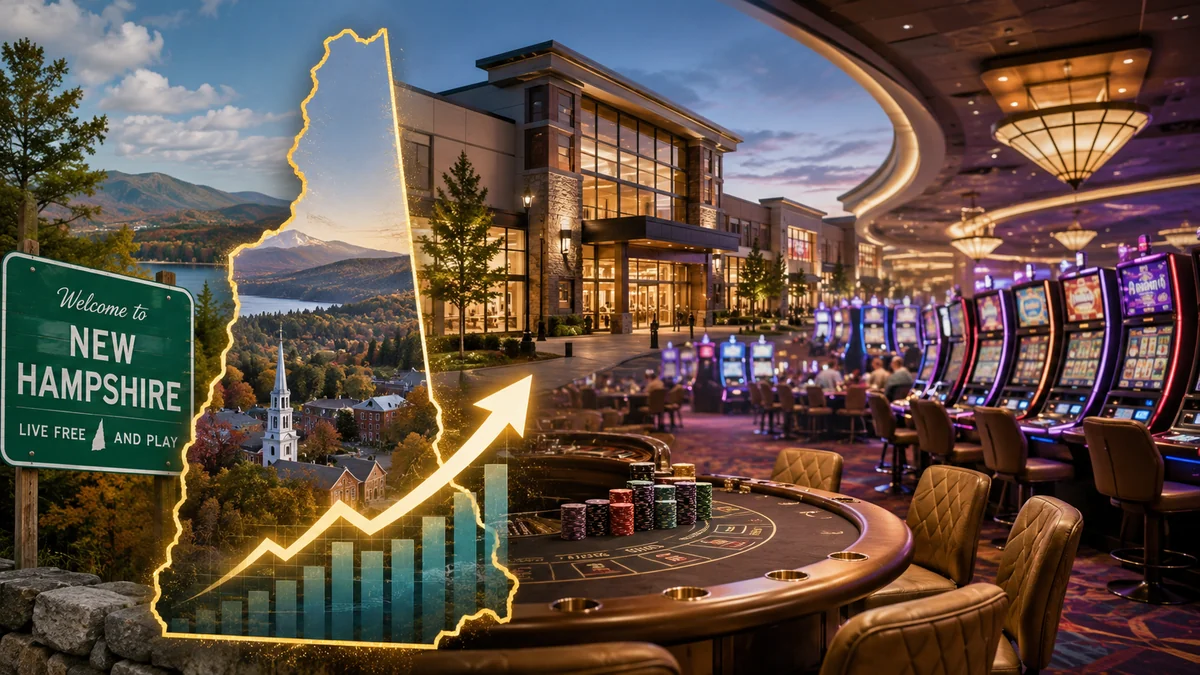
That frenzy is the product of decades of incremental change to the state’s gambling laws. What was once a patchwork of mom-and-pop charity halls has quietly grown into a booming, corporate-backed industry — floors packed with slot machines, live entertainment, restaurants and retail, positioning New Hampshire as the region’s next gambling hotspot.
The casinos are multiplying
The Nash is just one of 13 licensed gaming facilities in New Hampshire — and several more are on the way.
Casino Salem is set to reopen under new ownership at the Rockingham Park Mall, while the owners of the historic Hampton Beach Casino — which, notably, offered no actual gambling until 2014 — are planning a major overhaul that includes a 52,000-square-foot gaming floor. Beach Club Casino recently added 1,400 square feet and has bought a building in Littleton for a new venue.
Gate City Casino is relocating to the Sheraton Hotel, where a 93,000-square-foot gaming floor is in development, and Revo Casino and Social House rebranded several properties in 2024 with more renovations to come. In Seabrook, The Brook — the state’s second largest at 90,000 square feet, built on a former dog track — is wrapping up a 24,000-square-foot expansion of its own.
How “charitable” gaming actually works
It is a dramatic departure from the early days of charitable gaming, a model that requires casinos to hand 35% of their earnings to licensed New Hampshire nonprofits. An operator can partner with a given charity for up to 10 days a year before rotating to the next.
D’Allesandro, who decades ago championed a single casino at the old Rockingham Park horse track, remembers fierce resistance from lawmakers who saw gambling as immoral. As the rules loosened, the industry took off. “All of a sudden, this thing grew like topsy,” he said.
What started as small, family-run storefronts taking $2 wagers has become a network of investor-owned entertainment centers. Even longtime residents have been caught off guard. Christine Latino, now director of communications and charity at The Nash, once pictured the state’s casinos as “small, smoky poker rooms” — until she walked into the polished, upscale reality the renderings had promised.

The turning point: historical horse racing
The real inflection point arrived in 2021, with the legalization of historical horse racing machines. To the player they behave like any other slot machine, but their results are generated from the outcomes of real, previously run horse races.
Once they were approved, operators began building bigger rooms and investing heavily, said Republican State Rep. Joe Sweeney. “Now there are a handful of exciting projects,” he noted — adding jobs, pairing casinos with hotels and entertainment, and breathing new life into aging malls like Pheasant Lane and the old Rockingham Park site.
2020 — with limits lifted to $20, the checks jumped to about $50,000.
Today — at The Nash, a single nonprofit can collect up to $200,000 in ten days.
New Hampshire is the only state that channels gaming revenue to charity in this way. “What we have in place is unique,” D’Allesandro said. “I think we have the most open state in the United States for gambling.” Still, he conceded the line between charitable gaming and a traditional casino is razor-thin: “When you add ‘charitable’ to the name, it gives it a unique flavor. You can say, ‘I’m losing — but I’m losing for a charity.’”
A long road from the horse track
New Hampshire’s gambling story dates to 1933, when wagering began at Rockingham Park’s horse track. In 1963 the state launched the nation’s first legal state lottery. The pivotal move came in 2006, when lawmakers let for-profit companies run charitable gaming on behalf of nonprofits — charities taking 35% of gross table-game revenue, the state 10% for its general and education funds, and operators keeping the rest.
From there the limits kept climbing: betting caps rose from $4 to $10 to $50 before being scrapped entirely in 2026. Historical horse racing machines were legalized in 2021 and video lottery terminals in 2025. The payoff for a state with no income or sales tax has been steep — lottery-related revenue doubled from $308.6 million in fiscal 2016 to $605.4 million in fiscal 2025. Between 2021 and 2025, state revenue from charitable venues climbed 11% to nearly $60 million; in 2025 alone, nonprofits earned more than $64 million while operators pulled in close to $300 million in gross revenue.
The risks behind the boom
Not everyone is cheering. In 2025 the state passed a law letting cities and towns vote to “opt out” of casinos — and eight communities already have: Portsmouth, Barrington, Bedford, Croydon, Hancock, Henniker, Littleton and New London. The catch: the law only applies to future proposals, with venues already operating or in development shielded by a grandfather clause.
The human cost is harder to tally. The National Council on Problem Gambling estimates that about 2.5 million U.S. adults meet the criteria for a severe gambling problem in a given year, with millions more affected to a lesser degree. Younger players are especially vulnerable: those aged 18–24 face a “high risk” of developing gambling problems. New Hampshire’s legal age is 18, though some venues — The Nash among them — admit only those 21 and older.
Demand for help is rising in step with the industry. Angela Bergen, executive director of the New Hampshire Council on Problem Gambling, said the state helpline fielded 200 calls in 2021 — a figure that had climbed to 500 by 2025. The council is pushing for stronger safeguards, including a statewide voluntary self-exclusion program to replace the current casino-by-casino system.
Former casino owner James Rafferty, now on the board of the New Hampshire Council for Responsible Gaming, says the state can manage the risks with the right resources — backed in part by a new law that funnels 0.25% of VLT gaming revenue into a dedicated addiction-services fund. “We’re going to help those people,” he said.