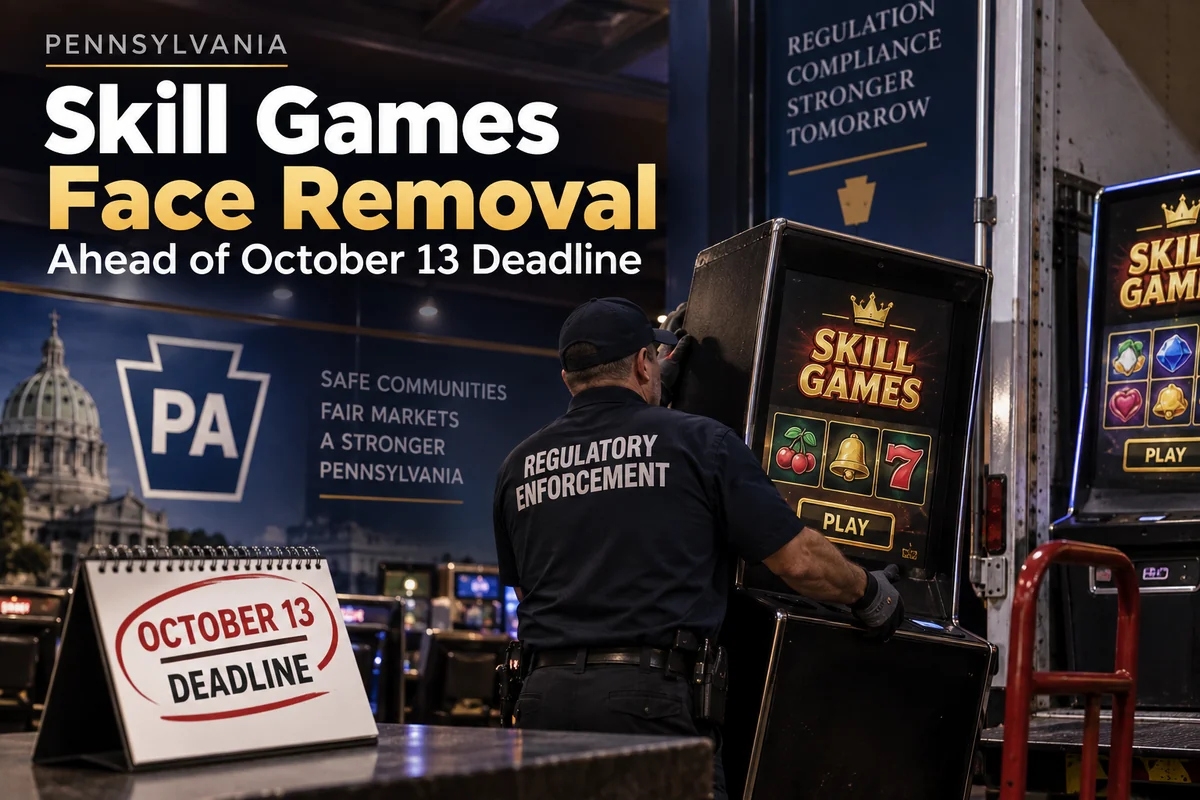
Pennsylvania's skill games are running out of time. Pennsylvania State Police have told bars, clubs and convenience stores to remove the machines before enforcement starts on October 14. They also warned that simply switching them off is not enough. With no deal in sight in Harrisburg, about 70,000 terminals could go dark.
Key takeaways
- On June 15, the Pennsylvania Supreme Court ruled that skill games are slot machines under the Gaming Act. It gave the state 120 days to comply.
- Lawmakers have until October 13 to regulate or tax the machines. After that, unlicensed units risk seizure and criminal charges.
- State Police want machines, equipment and ticket redemption terminals physically removed. Turning them off won't count.
- The Attorney General's Office estimates about 70,000 machines are affected across the state.
- Gov. Josh Shapiro proposed a 52% tax and a 40,000-machine cap, but talks in the legislature have stalled since July.
- The court split 4-2, reversing lower-court rulings that had treated the machines as games of skill.
The deadline follows a ruling that settled years of legal fighting. On June 15, the Pennsylvania Supreme Court found that skill games fall under the state's Gaming Act and count as gambling devices under the Crimes Code. That puts them in the same legal category as slot machines. In Pennsylvania, slots may only operate at licensed casinos and qualifying truck stops.
The court gave 120 days to comply. Lawmakers can pass a law to regulate and tax the machines by October 13. If they don't, any business running a machine without Pennsylvania Gaming Control Board approval faces prosecution. The Attorney General's Office estimates about 70,000 skill game terminals are operating across the state.
How the Court Got Here
The June decision reversed years of wins for the industry. In 2023, the Commonwealth Court found the machines to be "primarily of skill," largely because of a memory-based bonus round called "Follow Me" that lets players improve their payout. The Attorney General's Office and the Department of Revenue appealed, and the Supreme Court heard arguments in November 2025.
Writing for a 4-2 majority, Justice David Wecht pointed to a 2017 amendment that added "skill slot machine" and "hybrid slot machine" to the Gaming Act's definition of a slot machine. In the court's view, that change made the skill element legally irrelevant, so a skill component alone cannot take a device outside the slot machine category.
"It is not this court that declares ‘skill games’ to be unlawful. Rather, it is the General Assembly that did so nearly a decade ago."
— Justice David Wecht, Pennsylvania Supreme Court majority opinion
Attorney General Dave Sunday called the ruling "a significant victory for consumers, taxpayers and the rule of law in Pennsylvania." A 2025 study by the American Gaming Association and The Innovation Group put Pennsylvania's count of unregulated machines at about 67,000, more than a tenth of an estimated 625,000 nationwide.
"Remove," Not "Switch Off"
State Police guidance leaves little room for interpretation. Turning a machine off does not meet the law, the agency said. Businesses should arrange for the whole setup to be taken away: cabinets, related equipment and ticket redemption terminals.
The guidance, issued on September 9, was blunt: "Simply powering off an otherwise operable machine or unplugging them is not sufficient to comply with the law." State Police also noted that under the Crimes Code it is a crime to own, run or service a slot machine without a Gaming Control Board license, and said businesses whose distributor will not collect the machines can ask the agency to help get them removed.
"The PSP strongly recommends that businesses currently hosting such machines discuss their removal with any distributors or vendors."
— Pennsylvania State Police guidance
The risks are serious. Machines, related equipment and the revenue they generate can be seized and forfeited, and operators can face criminal charges.
Some operators think there's a simpler way. Lena Keares, who runs K&S Games in Lancaster, said the software will be disabled at midnight on October 13. Operators would later collect the dongles, the hardware keys that run the games, and might leave the terminals where they are. "There's nothing to be seized if there's no software," she said. "It is essentially just a wooden box." State Police have not said whether removing the software alone would be enough.
Pace-O-Matic Says It Will Comply
Pace-O-Matic, one of the leading skill game makers and a party to the Supreme Court case, says it will follow the deadline. "Pace-O-Matic has said since the June 15 Supreme Court ruling, we will abide by the imposed deadline," the company said.
It also warned about the effect on community groups: "A disruption of skill game revenue will harm American Legions, VFWs, volunteer firefighters, fraternal groups and small businesses."
Harrisburg Still Has No Deal
The court gave lawmakers a clear path to legalize the machines, but they haven't used it. Lawmakers have argued over the issue for years without passing rules. In August, Senate Majority Leader Joe Pittman said there had been no talks on the issue since July.
There are several proposals, and they are far apart:
- Gov. Josh Shapiro (February budget): a 40,000-machine cap and a 52% tax on gross terminal revenue. It was projected to raise $487 million in fiscal 2026-27 and over $1 billion a year after that.
- Sen. Chris Gebhard: a bill with a 35% tax.
- Pace-O-Matic: allow up to 50,000 machines, with a flat $500 monthly fee per device.
The gap is large. Casino operators have long argued that skill games should face the same rules as slots, and Shapiro's 52% rate is close to the 54% Pennsylvania casinos pay on slot revenue. The industry's own plan would charge a flat fee instead of a share of revenue.
That flat-fee model is written into House Bill 2213 from Rep. Danilo Burgos. It would put the Department of Revenue in charge, cap terminals at 50,000 and was expected to raise about $300 million a year. Sens. Anthony Williams and Gene Yaw have introduced a comparable Senate bill, and Pace-O-Matic has publicly backed HB 2213 along with Yaw's SB 1079. In September, Rep. Russ Diamond announced a package that would tax skill games at 20%, allow no more than five machines per club, bar or truck stop, and cut the casino slot tax to 49.9%. Gebhard has said he settled on 35% because the governor and other lawmakers were so far apart, and Shapiro's proposed tax was ultimately left out of the 2026-27 budget.
The House and Senate are not due back in session until September 28, and the legislature is set to adjourn for the year on November 30.
Legion Posts and Taverns Weigh the Cost
The businesses that host the machines are counting their losses. Jim Drier, commander of American Legion Post 34 in Lancaster, said the post's three machines bring in $500 to $1,800 a month. The money helps cover running costs and the post's charity work.
Taverns are thinking about their liquor licenses. Chuck Moran, executive director of the Pennsylvania Licensed Beverage and Tavern Association, said his members are being told not to gamble with them: "The advice that we've been given, now that we know for sure that they're illegal, is don't take a chance and do damage to your license."
For many bars, skill games became a lifeline after a 2016 law let many more stores sell beer to go, not just taverns and bars. Keares put it simply: "They truly do help the small businesses and the community."
Drier doesn't expect a dramatic crackdown. "The state police sent out these memos, and it made it sound like it's going to be Prohibition," he said, "but it's not going to be like that." Unless lawmakers act in the next few weeks, the machines will be illegal on October 14.