Sweden's Administrative Court has sided with the country's gambling regulator, confirming warnings and penalty fees against three licensed operators that failed to properly establish where their biggest young depositors' money was coming from.
Key takeaways
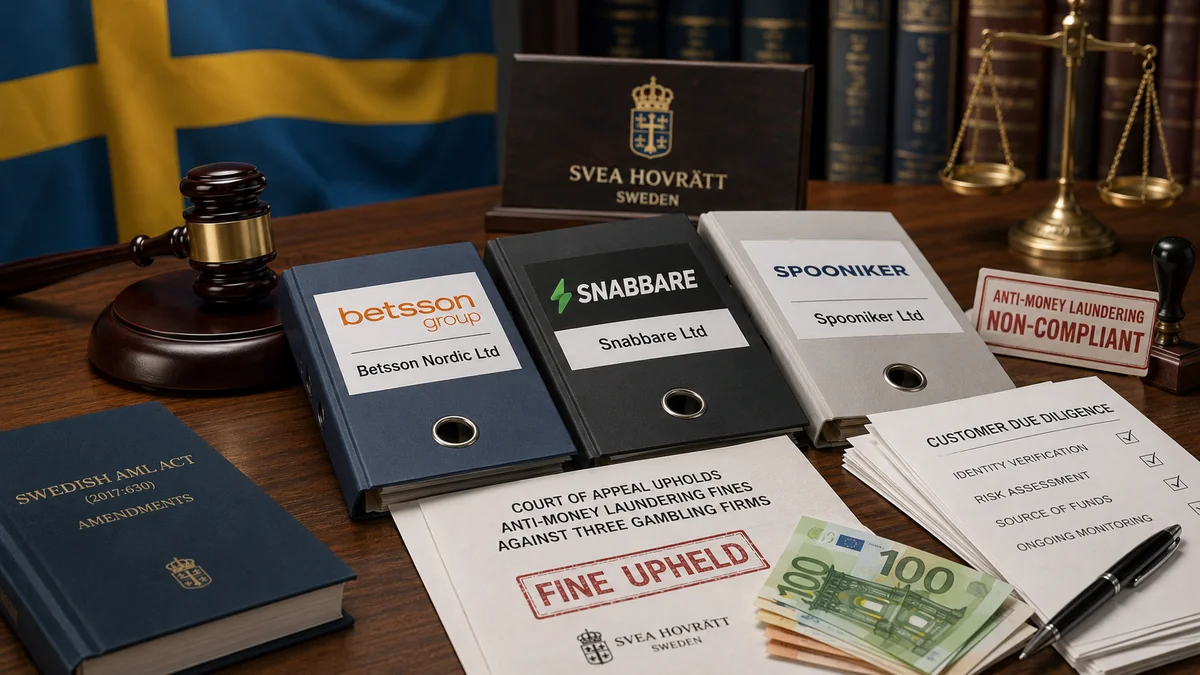
- The court upheld Spelinspektionen's May 2025 sanctions against Betsson Nordic, Snabbare and Spooniker.
- Combined penalty fees reach SEK 22 million — SEK 10m for Spooniker, SEK 6.5m for Betsson, SEK 5.5m for Snabbare.
- The cases grew out of a review of the 50 largest-depositing customers aged 18 to 29 during 2023.
- All three operators continue to reject the regulator's reading of the money laundering rules.
- The Administrative Court in Linköping delivered the three judgments on 2 July 2026; the regulator announced them the following day.
- Betsson's and Snabbare's breaches were judged serious but not systematic, while Spooniker's were treated as repeated because of a 2022 warning.
A Swedish administrative court has confirmed the enforcement measures imposed on three gambling companies, agreeing with the regulator that each committed serious breaches of anti-money laundering law by running inadequate customer due diligence checks.
The judgment leaves intact the decisions handed down by Spelinspektionen, Sweden's gambling authority, against Betsson Nordic Ltd, Snabbare Ltd and Spooniker Ltd. After examining each case, the court accepted the regulator's conclusion that the operators had not met the standards demanded of them for knowing and monitoring their customers.
Spelinspektionen confirmed that the court found ample grounds for both the warnings and the penalty fees. The original sanctions date to May 2025, following an investigation into how the three companies discharged their due diligence obligations. In the regulator's words, the operators were responsible for "serious violations of the money laundering regulations through insufficient customer due diligence measures."
The judgments came from the Administrative Court in Linköping on 2 July 2026 and were made public by Spelinspektionen a day later, with each operator's appeal decided in a separate ruling. In its 2025 decisions against Snabbare and Spooniker, the regulator noted that the breaches predated 1 June 2024, when Sweden changed how penalty fees for money laundering violations are calculated, so the older rules applied and capped each fee at the equivalent of EUR 1 million.
The Court Backs the Regulator
The proceedings trace back to a targeted review of younger players. Spelinspektionen pulled the 50 customers aged between 18 and 29 who had deposited the most across the calendar year running from 1 January to 31 December 2023, then asked what the operators knew about them.
What the regulator found was that none of the three had done enough to establish the source of the money once deposit totals began to look out of step with the players' declared taxable income. In several instances customers were putting in sums that simply could not be squared with their reported earnings, and the operators let the play continue without pinning down where the funds had come from.
The court accepted that reading of the evidence and held that the shortcomings were serious enough to justify regulatory intervention. Betsson was handed a warning and a penalty fee of SEK 6.5 million. Snabbare was ordered to pay SEK 5.5 million. Spooniker drew the heaviest sanction of the three at SEK 10 million.
On the central point the court used near-identical wording in all three judgments: "an assumption that deposits consist of previous winnings is not an enhanced customer due-diligence measure", whether or not the customer used the same bank account to deposit and withdraw. That leaves little room for the closed-loop argument, under which a deposit is treated as low risk simply because it mirrors money the player withdrew earlier.
One Customer, 163 Deposits
The single case that came to define the investigation involved a Betsson customer who made 163 separate deposits between 19 September and 30 December 2023, totalling SEK 491,950. That player had reported an annual net income of SEK 310,000. Throughout the entire period, according to the regulator's findings, the account's internal risk classification never rose above medium.
Spelinspektionen's position was that no serious attempt had been made to investigate how such a level of play was being funded.
The operators countered that the deposits were explained by earlier gambling winnings being recycled back into play. The regulator was unpersuaded, pointing out that the provenance of those funds had never actually been verified through due diligence procedures. The court agreed the legitimacy of the deposits had not been demonstrated, and the sanctions stood.
How Each Case Played Out
Betsson's appeal concerned eight customers from a reviewed group of ten, whose deposits over a few months ranged from SEK 133,584 to SEK 491,950. The court accepted that so small a sample could not show systematic failings, but still classed the breaches as serious and declined to cut the fee.
Snabbare's case involved ten customers who each deposited between roughly SEK 950,000 and SEK 3.2 million. The operator pointed to 139 manual checks and a report it had filed with the Swedish Financial Police, and argued that encouraging players to withdraw winnings lowered risk. The court did not accept that as a substitute for monitoring, although it again stopped short of calling the lapses systematic.
Spooniker's file covered just five customers, but the company had already been warned in 2022 for the same type of shortcoming, which led the court to treat the new breaches as repeated rather than isolated.
Operators Push Back on the Interpretation
The ruling has not settled the argument. All three companies continue to contest how the regulator reads Sweden's anti-money laundering requirements, and Betsson has been the most forceful, arguing that Spelinspektionen has adopted an unreasonably narrow test for funds traceable to prior withdrawals.
"The interpretation of the Swedish Gambling Authority – that licensees may only take into account previous withdrawals if they have verified that they are indeed from there as later deposits by continuously obtaining account statements – is incorrect. It goes against the previous practice of the administrative court, the preparatory work of the money laundering regulations and supranational guidance. Furthermore, it lacks a connection to both the risk-based approach and the facts of the case."
— Betsson
Betsson further contends that the decision offends the principle of equal treatment, noting that the administrative court has previously overturned decisions covering what it calls comparable but more serious circumstances — cases in which operators obtained no income information at all, permitted substantially higher net deposits without due diligence, and repeatedly ignored their documentation obligations. The company also invokes the principle of legality, arguing it had no way to anticipate the standard the regulator has now applied. Its violations, it maintains, were neither systematic nor serious, and any sanction fee should be waived or cut sharply.
Snabbare, owned by ComeOn Group, likewise rejected the regulator's conclusions, describing Spelinspektionen's position as "wrong for several reasons". Spooniker — formerly part of FDJ United and no longer operating in the Swedish market — was similarly critical, calling the authority's decisions "consistently imprecise".
A Backdrop of Black-Market Pressure
The timing is awkward for an industry that has spent months warning Stockholm about the ground being ceded to unlicensed competitors. Industry estimates cited alongside the ruling put revenue from Sweden's black-market gambling sector at somewhere between SEK 3.6 billion and SEK 7.3 billion, on gross turnover of anywhere from SEK 60 billion to SEK 120 billion.
That debate over channelisation is far from over. What this judgment settles, at least for now, is the narrower question of the regulator's reach: by endorsing the findings against Betsson, Snabbare and Spooniker, the Administrative Court has affirmed that weak customer due diligence is enough, on its own, to earn a licensed operator both a formal warning and a substantial financial penalty under Swedish law.