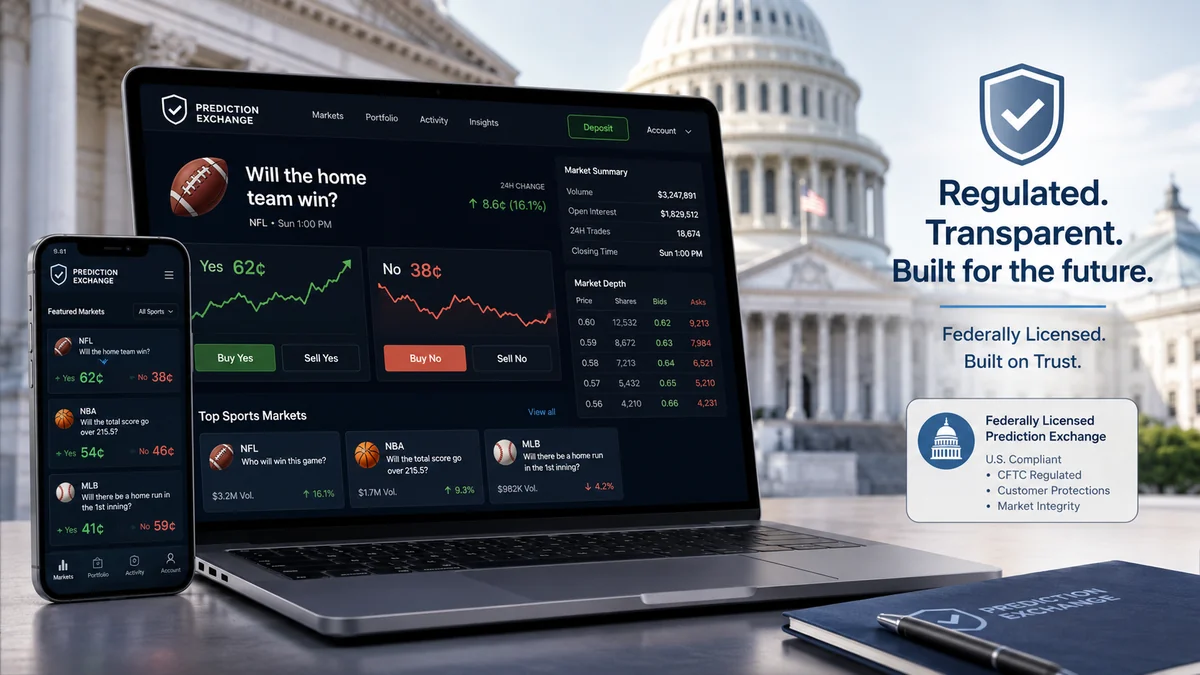
Underdog has switched on its own federally licensed prediction exchange, turning the sports prediction-market and fantasy operator from a middleman into a fully integrated venue with end-to-end control over its markets.
The Key Takeaways
- Underdog's new exchange runs on the CFTC-licensed UDX platform it acquired via Aristotle Exchange in March 2026.
- The first filings self-certify seven sports event-contract templates covering baseball, basketball and broader outcome markets.
- The move mirrors DraftKings' DKeX launch as U.S. operators race to own their prediction-market infrastructure.
- UDX set up a trading fee schedule and a certified market maker program before launch, so exchange fees on UDX trades stay with Underdog instead of going to partner venues.
The launch follows Underdog's acquisition of Aristotle Exchange DCM, Inc. (UDX) and Aristotle Exchange DCO in March 2026 — a deal that handed the company Designated Contract Market and Derivatives Clearing Organization status under the Commodity Futures Trading Commission (CFTC). With that license stack in hand, Underdog no longer needs to route its markets through anyone else.
"Now with our own exchange, we're going to unlock so much for more sports fans. Prediction markets are largely about sports, and Underdog is the best at sports."
— Jeremy Levine, CEO and Co-Founder, Underdog
Levine announced the launch on Friday, July 17, in an interview with CNBC, and the company followed with a formal press release the next day. He also rejected the idea that owning an exchange would turn Underdog into an infrastructure supplier for other platforms, telling CNBC: "It's not a change for us at all. It's just a different regulatory framework."
Vertical Integration and Market Control
Until now, Underdog offered prediction markets through outside venues such as Crypto.com and Kalshi. Owning its own exchange gives the company direct control over contract design, trading rules and settlement — cutting its reliance on third parties while keeping existing partnerships in place, and opening the door to faster product development and tighter financial oversight.
The exchange's opening filings, self-certified with the CFTC on July 15, include seven sports event-contract templates aimed at baseball, basketball and broader outcome-based markets. They span game-winner, winning-margin and total-score contracts, plus a catch-all template for individual athlete, team or event outcomes. Each contract carries a $1 notional value and trades between $0.001 and $0.999, with set position limits for participants and market makers.
The filings also allow multiple outcomes to be combined with AND/OR logic — effectively bundling results without invoking the word "parlay." Formal trading start dates are still pending, but the paperwork signals Underdog's intent to list contracts no later than July 17, 2026.
Under self-certification, a registered Designated Contract Market vouches on its own authority that a new contract meets the Commodity Exchange Act and CFTC rules, so the product can be listed without a Commission vote; the agency keeps watch afterward through market surveillance and reviews of how the exchange enforces its rulebook. Three of the UDX templates are for baseball and three for basketball, and each can be tied to a whole game or only part of one, such as a single inning, quarter or half.
How UDX Was Readied for Launch
The contract filings capped a series of rule changes. UDX's market maker program, certified on July 2, obliges approved firms to quote prices on both sides of the book, which gives retail traders a counterparty when they want to open or close a position. A rewritten Aristotle rulebook took effect on July 16, spelling out how individual customers open, fund and clear accounts and letting UDX contracts sit inside the existing Underdog app. A separate proposal to add a request-for-quote tool for large orders was still awaiting CFTC review when trading began, so that function may come later.
The exchange's published fee schedule charges makers and takers under a single formula that depends on how many contracts change hands and at what price, with the charge largest for contracts priced around 50 cents. On a 10-contract order, the rounded fee works out to 18 cents at a 50-cent price and 12 cents at a 20-cent price. Exchange fees on Underdog's volume used to go to Kalshi or Crypto.com's exchange; on UDX trades they stay inside a company Underdog owns.
From Fantasy Start-Up to Exchange Owner
Underdog started out in 2020 as a fantasy sports operator and later added a sportsbook, and its $70 million Series C round gave it a $1 billion valuation. The turn toward prediction markets has reshaped the business since then: the company applied in April 2025 to register as a swap firm and Futures Commission Merchant, launched its Predictions product inside its fantasy app in September 2025, shut its only sportsbook operation, in North Carolina, in late 2025, and cut at least 125 jobs, just over a fifth of its workforce, in layoffs that staff learned about on February 27, 2026.
When the Aristotle acquisition was announced in March 2026, Levine said: "We're in the early innings of what prediction markets can be, especially for sports fans."
Industry Implications and Future Outlook
Underdog's move lands amid a wider push toward vertical integration across the U.S. prediction-market sector. DraftKings recently rolled out its own DKeX exchange, a sign that operators increasingly want to own both the economics of each transaction and their regulatory compliance.
DraftKings built DKeX on the CFTC-approved exchange it bought from Railbird, and Rothera, the former LedgerX exchange and clearinghouse, is now 90% owned by a joint venture of Robinhood and Susquehanna. The change has come quickly: Crypto.com self-certified the first regulated sports event contracts in the U.S. in late December 2024, and Kalshi became the second company to do so in January 2025.
Since September 2025, Underdog has processed close to $6.5 billion in notional prediction-market volume — third among U.S. operators and ahead of several established rivals. The company has also secured Futures Commission Merchant status, making it, by its own account, the first U.S. sports company with a complete federal license stack for prediction markets.
On-screen graphics during Levine's CNBC appearance listed Underdog's total at $6.49 billion, a whisker above Polymarket US at $6.48 billion and far beyond DraftKings Predictions at $1.2 billion, while Levine placed Kalshi and Robinhood in the top two spots. The same graphics showed Underdog with more than 5 million registered customers and annual revenue above $500 million. Because UDX had only just gone live, that volume was generated through Underdog's partner exchanges.
Levine framed the launch as a response to growing fan appetite for a wider spread of betting and prediction products. Underdog plans to extend the exchange beyond sports into cultural events and broader outcome markets, leaning on its daily-fantasy and sports-betting expertise to grow market share while staying inside CFTC requirements.
The Regulatory Risk That Comes With Sports
Leaning so heavily on sports carries exposure. States contend that sports event contracts are sports wagering offered without a state license, while the CFTC holds that registered exchanges answer to federal oversight alone, and that disagreement is now being litigated in several states. Regulators in Nevada and Michigan have already obtained court orders that temporarily limit Kalshi's sports contracts inside their borders. According to DeFi Rate, Underdog's Predictions product is already unavailable in a number of states that have moved against sports event contracts, including New Jersey, Pennsylvania, Ohio and Michigan. Should courts or federal policymakers eventually narrow what sports contracts can be offered, the core product UDX was built around would take a direct hit.