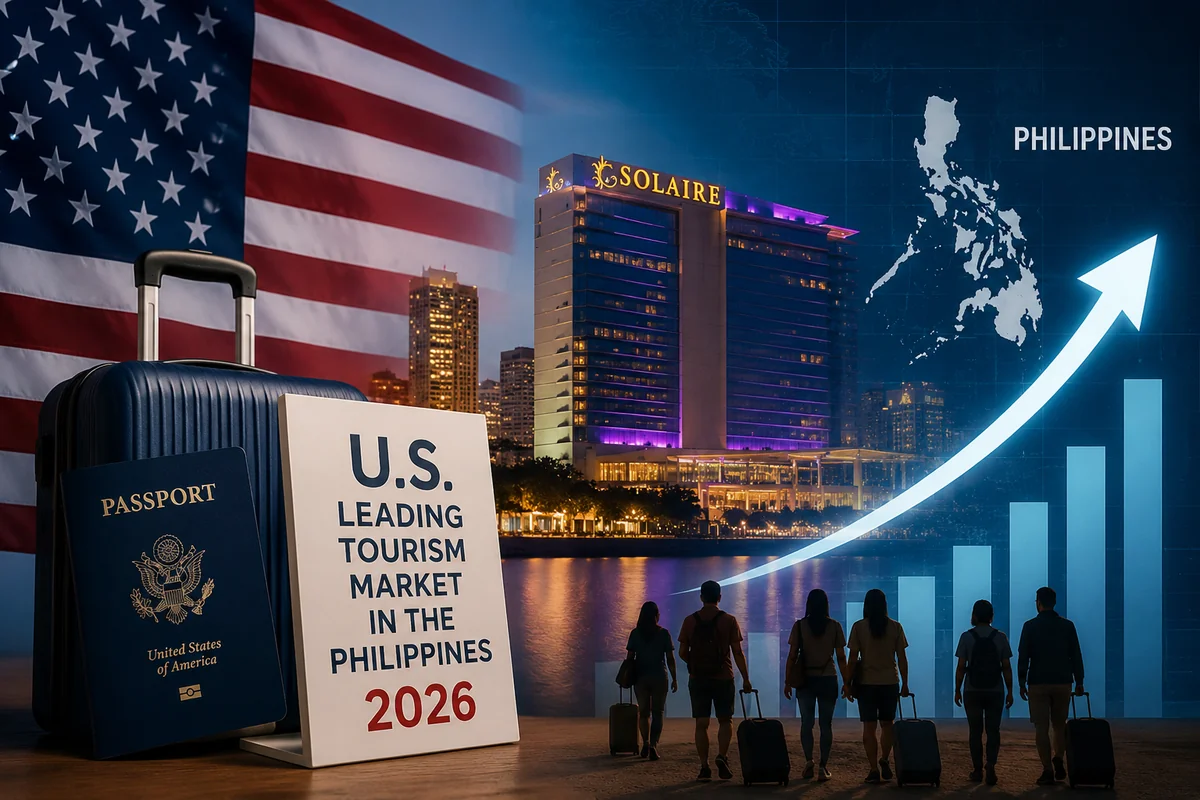
The United States has edged past South Korea to become the Philippines' biggest source of international visitors in the opening months of 2026 — a notable reshuffle after years of Korean dominance at the top of the rankings.
Key takeaways
- The US logged 531,859 arrivals from January to May 2026, edging out South Korea's 501,789.
- Korean arrivals fell 9.56% year-on-year amid security concerns, while US numbers grew 7.07%.
- China rebounded sharply (+62.8%) and total arrivals rose 7.51% to over 2.7 million.
- Analysts expect visa-free entry for Chinese nationals to help Manila's Entertainment City casinos, but only gradually, after a weak 2025 for the resorts.
A new leader at the top
Figures released by the Department of Tourism (DOT) and reported by Philstar show the Philippines welcomed 531,859 visitors from the United States between January and May 2026, just ahead of South Korea's 501,789. That gave the US a 19.40% slice of total inbound arrivals, compared with 18.31% for South Korea.
For years, South Korea reliably supplied the most tourists to the Philippines, so the switch marks a genuine turning point. US arrivals climbed from 496,742 in the same five-month window last year — growth of 7.07% — while Korean numbers slipped from 554,855, a fall of 9.56%.
The first quarter had already hinted at the handover. DOT data for January to March put the US in front with 393,137 arrivals, up 5.9% and equal to 20.8% of all visitors, while South Korea supplied 385,569, down 10.2%. Japan came third with 144,509, a rise of 7.8%, and Canada, Australia and the United Kingdom all grew too, by 16.3%, 13.4% and 3.2% respectively. Taiwan was another bright spot, up 26.3% to 66,818.
Why Korean arrivals are sliding
The steady drop in Korean visitors has tracked closely with safety worries raised by authorities in Seoul. In 2025, the Korean Embassy in Manila cautioned its citizens about crime-related risks following a string of incidents involving Korean nationals — including robberies, kidnappings and homicides — and urged travellers to avoid unnecessary movement, especially late at night.
Those concerns show up clearly in the month-by-month data, with Korean arrivals declining steadily through the early part of 2026:
| Month (2026) | South Korean arrivals |
|---|---|
| January | 149,964 |
| February | 131,535 |
| March | 91,525 |
| April | 67,803 |
| May | 60,962 |
The US had already outpaced South Korea for three months in a row, but 2026 is the first year it has led on a combined year-to-date basis. South Korea still finished 2025 on top overall — with 1,346,301 visitors — even as that market shrank by 18.5% across the year.
The slide was visible well before the year ended. In an October 2025 note, Maybank Securities said arrivals from South Korea and China in the first nine months of that year had fallen 21% and 22% respectively, at a time when total foreign arrivals were down 3.5% at about 3.9 million. By the close of 2025, the Philippines had welcomed roughly 5.94 million foreign tourists, only marginally above the 5.93 million of 2024.
China bounces back
There was a strong recovery from mainland China, where arrivals jumped 62.8% year-on-year to 187,478 — enough to reclaim fourth place among the Philippines' top source markets. Analysts at Maybank Securities suggested government efforts to boost travel are starting to pay off, citing visa-free entry arrangements and an expanded e-visa programme.
China's numbers had previously been dented by safety concerns and maritime tensions between Manila and Beijing. The DOT also flagged a methodology change from March, with arrivals now counted by residency rather than citizenship.
The policy changes came in two steps. In November 2025 Manila reopened its electronic visa programme to Chinese applicants for stays of up to 14 days, with entry through Ninoy Aquino International Airport in Metro Manila or Mactan-Cebu International Airport. On 16 January 2026 it went further, letting Chinese nationals travelling for tourism or business enter through those two airports without any visa for a non-extendable 14-day stay. The Department of Foreign Affairs said the arrangement would run for one year and be reviewed before it lapses. Indian tourists had been given 30-day visa-free entry from June 2025.
Officials warned at the outset that the payoff would not be instant. Speaking in October 2025, then-Tourism Secretary Christina Frasco said rebuilding the Chinese market would need months of preparation:
"The market penetration, I anticipate, will only be next year. As we can see in the results of any marketing campaign, it's a work of at least six months before you can see actual conversion."
— Christina Frasco, then Philippine Tourism Secretary, as cited by the Philippine News Agency
Top source markets — share of arrivals
- United States — 19.40%
- South Korea — 18.31%
- Japan — 8.26%
- China — 6.84%
- Canada — 6.06%
What the shift means for Manila's casinos
For the gaming industry, the mix of visitors matters as much as the total. The Philippines is one of the few Asian jurisdictions with a large casino sector open to both locals and foreigners, and the casino resorts of Manila's Entertainment City saw fewer visitors arrive from China during 2025. Maybank calculated that Entertainment City's combined gross gaming revenue fell 15% year-on-year to PHP99.4 billion in the first nine months of 2025. It linked part of that drop to fewer fly-in VIP players, pointing to a 50% fall in VIP revenue at Bloomberry's Solaire Resort & Casino, where roughly 30% of gaming revenue came from Greater China.
Maybank called the visa waiver a positive for Entertainment City operators, but warned that a meaningful recovery in gaming activity would probably take several quarters. Morgan Stanley was blunter. Speaking at G2E Asia in Macau in May 2026, its head of Asian gaming and lodging, Praveen Choudhary, described the Philippine land-based market as struggling. Official data released in April had shown gross gaming revenue at licensed land-based casinos down 9.6% to PHP182.50 billion for 2025.
"I don't have a view that 2026 will be better; it still looks challenging."
— Praveen Choudhary, Managing Director and Head of Asian Gaming and Lodging, Morgan Stanley
Choudhary also pointed out that arrivals from South Korea and China had dropped by double digits in the first quarter of 2026, even after the visa rules for mainland visitors were relaxed. For casino operators, then, the pace of the Chinese recovery may matter more than which country heads the overall arrivals table.
Overall growth stays healthy
Across all markets, the Philippines drew 2,741,117 international visitors from January through May — a 7.51% increase on the same stretch of 2025. Tourism Secretary Dita Angara-Mathay said the government plans to deepen tourism investments and partnerships with American companies and industry players to keep US demand strong.
Taken together, the surge from the US, the slide in Korean travel and China's revival have reshaped the Philippines' tourism map in the first half of 2026 — and set up an intriguing race for the rest of the year.