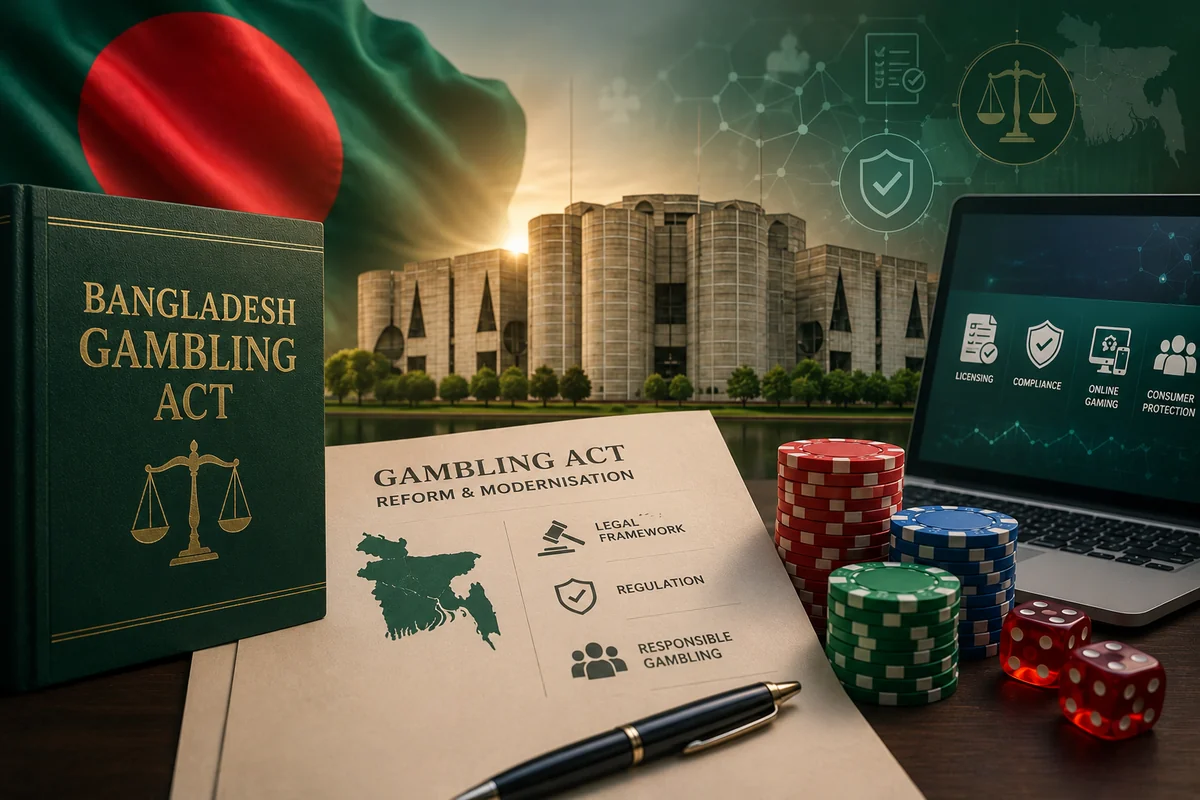
Bangladesh is preparing the biggest shake-up of its gambling rules in more than 150 years. The cabinet has given in-principle approval to the draft Gambling Prevention Act, 2026, a law built to replace the colonial-era Public Gambling Act of 1867 and finally bring online betting, digital wallets and match-fixing inside the reach of the state.
Key takeaways
- Cabinet approved the draft Gambling Prevention Act, 2026 at its 10th meeting, chaired by PM Tarique Rahman.
- The bill would retire the 1867 Public Gambling Act, in force for over 150 years.
- New definitions cover digital platforms, remote betting, digital wallets, totalisators, bookmakers, match-fixing and spot-fixing.
- Offenders could face fines, imprisonment or both, with penalty details fixed during legislative review.
- The cabinet decision on 18 June followed a nationwide enforcement drive announced by Home Minister Salahuddin Ahmed in April and a pledge in May to bring a replacement law to parliament.
The Bangladeshi government has signed off in principle on a sweeping rewrite of its gambling legislation, moving the draft Gambling Prevention Act, 2026 forward at the 10th Cabinet meeting chaired by Prime Minister Tarique Rahman. The decision marks a wholesale revision of a legal framework that has stood for more than a century and a half.
The session was held in the Cabinet Room at the Jatiya Sangsad Bhaban, where the Ministry of Home Affairs tabled the draft. Officials explained that the proposal is meant to replace and modernise the Public Gambling Act of 1867, a statute they regard as out of step with today's fast-moving digital technologies.
According to the cabinet summary, the new law is a response to the surge in both online and offline gambling driven by modern communication tools, mobile devices and digital payment systems. The government framed the reform as a way to protect public order, curb criminal activity, limit social and economic harm, and tackle the psychological risks tied to gambling.
How the bill reached the cabinet table
Ministers signed off on the draft at a meeting on 18 June 2026. The decision was the latest step in a push that Home Minister Salahuddin Ahmed has led since spring. In late April, after Noakhali-2 lawmaker Zainul Abdin Farroque raised concerns about gambling, the minister set out a "zero tolerance" approach and said all law enforcement agencies would run joint operations against drugs and gambling once the parliamentary session closed on 30 April.
A month later, speaking to the Bangladesh Secretariat Reporters Forum in Dhaka on 24 May, the minister described online betting as a major threat to the country's young people, its economy and its stability, and argued that the existing legal framework was no longer adequate for betting driven by new technology.
"The drafting process of the new law is in its final stage and the bill will be placed in the next session of parliament for passage."
— Salahuddin Ahmed, Home Minister, Bangladesh
A legal framework built for the digital era
One of the draft's defining features is a formal set of definitions spanning a broad sweep of gambling concepts. They cover gambling premises and equipment, digital gambling platforms, online and remote betting systems, digital wallets, digital assets, totalisators, bookmakers, and practices such as match-fixing and spot-fixing.
The bill also widens its reach to offences tied to running a gambling operation — organising, facilitating, promoting and providing technical support for illegal betting systems. Authorities say this mirrors the increasing sophistication of digital gambling networks, which frequently run through cross-border platforms, social media channels and online payment services.
The legislation is written to capture both traditional and technology-driven gambling. Officials stressed that cyber-enabled betting systems have produced enforcement headaches the existing laws were never designed to deal with.
Under the proposed act, those caught could face fines, imprisonment, or both, scaled to the seriousness of the offence. The precise sentencing guidelines and penalty bands are expected to be settled during the legislative review.
The draft additionally targets organised gambling networks, paying particular attention to syndicates behind large-scale illegal betting. Law enforcement has previously flagged cases in which users were recruited onto foreign betting platforms and digital financial channels were used to move money.
Before it can advance to final approval, the bill will be vetted by the Legislative and Parliamentary Affairs Division.
Confronting the risks of digital betting
Officials and analysts have voiced concern over how quickly online gambling is spreading, especially among younger people. Smartphones, messaging apps and online financial tools have made betting far easier to access, feeding rising participation in informal betting markets.
Security and policy specialists have also flagged the difficulty of policing operators based beyond national borders, where enforcement is far harder. Because these platforms typically span several countries at once, conventional regulatory tactics tend to fall short.
The draft introduces dedicated criminal provisions aimed at match-fixing and spot-fixing. Authorities see these as a mounting danger to the integrity of sport, a risk that grows as illegal betting markets swell around major international competitions.
Observers of sports governance note that betting-driven manipulation can erode trust in professional sport and open the door to corruption within competitive systems.
Following the money
Much of the enforcement work so far has targeted the payment channels that illegal operators depend on. Bangladesh Bank has told all 13 mobile financial service providers in the country to stop handling transactions linked to gambling, and earlier financial intelligence investigations led to the suspension of 21,725 accounts suspected of carrying betting money. In May 2025, the Criminal Investigation Department said it had identified more than 1,000 financial service agents it believed were tied to illegal gambling payments and passed their details to the central bank.
Penalties have also been tightened once already. The Cyber Security Ordinance 2025 introduced punishments for running or promoting online gambling, reported as up to two years in prison and fines of up to roughly $80,000. Trade press coverage of the April crackdown read the renewed push as a sign that those penalties had not dented the black market as intended. Neighbouring India has taken a similarly hard line: its ban on online real-money gaming, passed by parliament in August 2025, was set to be enforced from 1 May 2026.
As reported by Bangladesh Pratidin, the Gambling Prevention Act, 2026 forms part of a broader push to modernise the rules governing gambling and related crime. The proposal updates the colonial-era Public Gambling Act of 1867, still the backbone of current gambling restrictions in the country.
The existing law already bans most forms of gambling, allowing only narrow exceptions such as certain horse-racing bets and state-sanctioned lotteries. The new framework is intended to stretch that legal coverage into the digital spaces where the old rules barely apply.
At the same sitting, the cabinet greenlit related legislative changes, including amendments to address digital cheating in public examinations and revisions to narcotics control laws — parallel reforms that reflect a wider drive to rework legal structures around technology-driven crime.
With in-principle approval secured, the draft now heads to parliamentary legislative authorities for review ahead of final consideration. Officials have not set a timeline for when it might fully take effect.
Should it pass, the act would stand as one of the most far-reaching updates to gambling regulation in Bangladesh in over 150 years, sharpening enforcement powers and extending the state's authority deep into digital gambling.