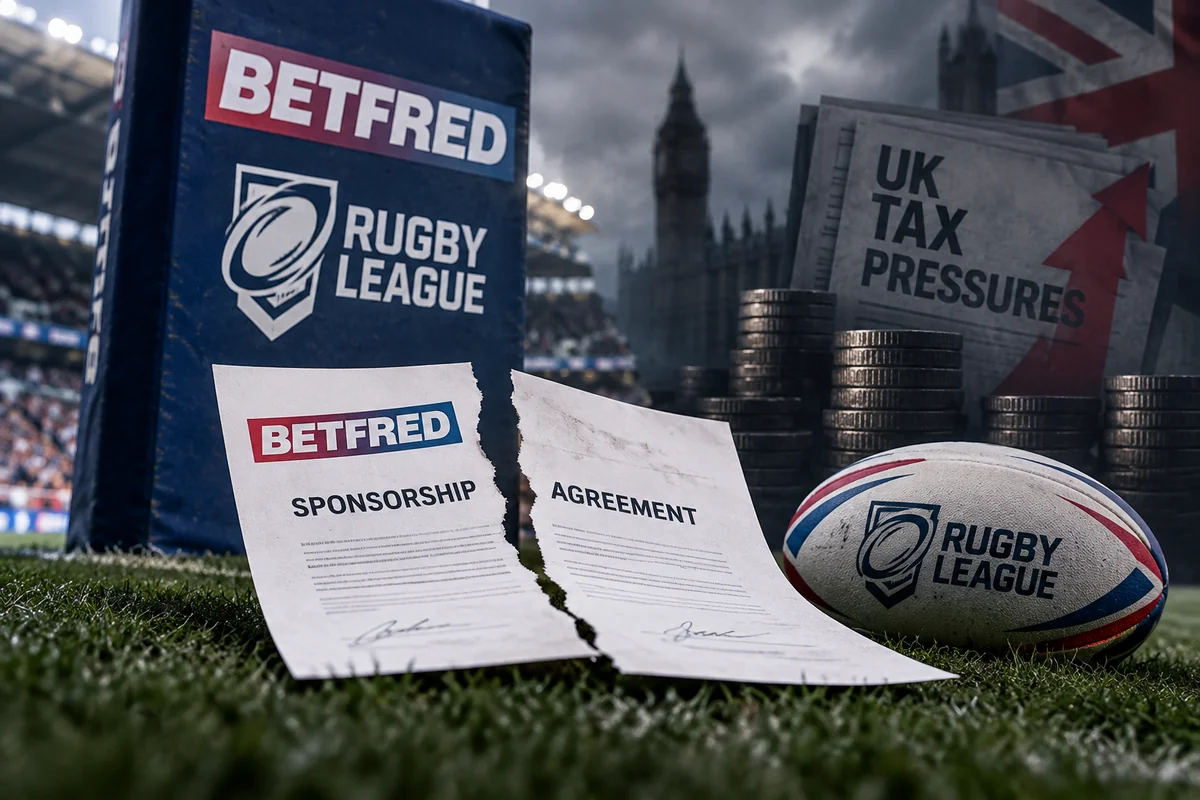
After nine years as rugby league's most visible commercial backer, Betfred is stepping away. The bookmaker will let its title sponsorship of the Super League, the Challenge Cup and England Rugby League lapse once the 2026 season finishes, and founder Fred Done is placing the blame squarely on the UK's climbing gambling tax bill.
Key takeaways
- Betfred's rugby league deal, in place since 2017, ends after the 2026 campaign.
- The decision follows 132 betting shop closures announced in July, affecting more than 600 staff.
- Remote gaming duty jumped from 21% to 40% in April; a 25% online sports betting duty arrives in 2027.
- Done warns a Machine Gaming Duty rise to 40% would shutter a further 495 shops.
- Betfred's sponsorship of Britain's five Classic horse races is also on the line ahead of October's budget.
Betfred's name has been attached to the top of English rugby league since 2017, covering the Super League, the Challenge Cup and the national team. That run now has an end date: the current agreement expires when the 2026 season wraps up, and the operator has chosen not to renew it. The timing lands in the middle of a wider retrenchment at the company rather than in isolation.
Only a few months earlier, Betfred confirmed it would shut 132 shops across the UK, a decision expected to cost more than 600 jobs. At the time the bookmaker pointed to the same pressures it is citing now — heavier taxation and an uncertain economic backdrop that forced a fresh look at the retail estate.
"We look back with great pride and fondness at our partnership with rugby league, which began in 2017. Regrettably, following last year's extremely disappointing budget, and the ensuing combination of tax rises and wage inflation that led directly to the 132 shop closures we announced in July, it has been necessary to review all Betfred spending. It is with a very heavy heart that we have taken the decision not to extend our support."
— Fred Done, Betfred founder (via Warrington Guardian)
A Sponsorship Casualty of a Broader Squeeze
Dropping the rugby league deal is one line item in a much larger cost review. Betfred has consistently named the same set of culprits: rising gambling duties, a steeper employer National Insurance bill, wage inflation and general economic softness.
The duty changes are substantial. Remote gaming duty climbed from 21% to 40% at the beginning of April. From 2027, a new 25% online sports betting duty is due to apply across most sports markets, with horse racing carved out. Those two measures have become the company's standard explanation for nearly every recent contraction.
"We have tried hard to protect all our sites and the colleagues who work in them, but the combined impact of higher employer National Insurance contributions, wage inflation, increases in gambling taxes and wider economic uncertainty has left us with no choice."
— Jo Whittaker, Betfred Chief Executive
The estate that remains numbers roughly 1,100 shops, with some counts putting the figure closer to 1,094. Betfred has made clear that number is not safe if taxation keeps climbing.
The specific proposal drawing Done's fire is a potential increase in Machine Gaming Duty from 20% to 40%. Fixed-odds betting terminals still generate roughly half of the profit made in Betfred's shops, which makes the machine tax an existential question for the retail model rather than a marginal one. By the company's own modelling, that change would close 495 shops and eliminate somewhere between 2,475 and 2,575 jobs, while knocking around £67 million off the Treasury's own tax take.
"I believe that by 2030 we will have no betting shops. The high street will be dead. We've already worked it out that with the increases in taxes and salaries and other wages it won't be worth operating."
— Fred Done
Horse Racing Could Be Next on the List
Rugby league may not be the only sport to lose Betfred's money. The operator currently backs all five of Britain's Classic races — the Derby, the Oaks, the St Leger, the 2,000 Guineas and the 1,000 Guineas — and Done has signalled that renewal depends on what happens in Westminster.
"We have a verbal agreement to renew our sponsorship of the British Classic horse races for a further three years – but if October's budget goes the wrong way on MGD, we will have to walk away from those too."
— Fred Done
His message to policymakers has been blunt. Done argues the sector is out of headroom, and that further duty increases would do more damage to investment, employment and racing's funding base than they would raise in revenue.
"I'm not asking anyone to feel sorry for bookmakers. But I am asking the government to open their eyes. You can't squeeze any more out of this industry. Every penny more of tax will kill investment, kill jobs, and kill horseracing."
— Fred Done
He has also pushed back on how betting shops are characterised in political debate, noting that the average stake placed across the Betfred estate is £10.87 and describing a customer base of working people rather than high rollers. Each closure, he argues, removes footfall that neighbouring high street businesses rely on — and he took particular exception to betting shops being lumped in with vape retailers and "rogue operators" in recent government commentary.
On the fairness argument, Done offered a pointed figure: the Done family paid £400 million in tax last year, topping The Sunday Times Tax List and ranking as the UK's largest taxpayers. The brothers founded Betfred in 1967.
Rugby League Looks for a Successor
The sport's governing bodies responded with thanks rather than alarm, and with a clear signal that replacement partners are already being lined up for the post-2026 era.
"Betfred has been an outstanding partner across rugby league for nearly a decade. We are extremely grateful to Fred Done and the entire Betfred team for their backing, passion, and dedication to our sport. But, on the back of a record-breaking Super League season, we are also excited for this next chapter as we prepare to soon welcome in new partners."
— Rhodri Jones, interim RFL CEO and RL Commercial managing director
Before the partnership formally ends, both sides still have the play-off series, the grand finals and the Rugby League World Cup to get through together. After that, the sport enters the commercial market at a moment when its longest-standing backer is arguing that the economics of UK bookmaking no longer support that kind of spending.
That is the wider significance of Betfred's exit. Sponsorship budgets are usually the first thing trimmed when margins tighten, and British sport has leaned heavily on betting money for decades. With October's budget approaching and Machine Gaming Duty still undecided, rugby league may turn out to be the first domino rather than the last.