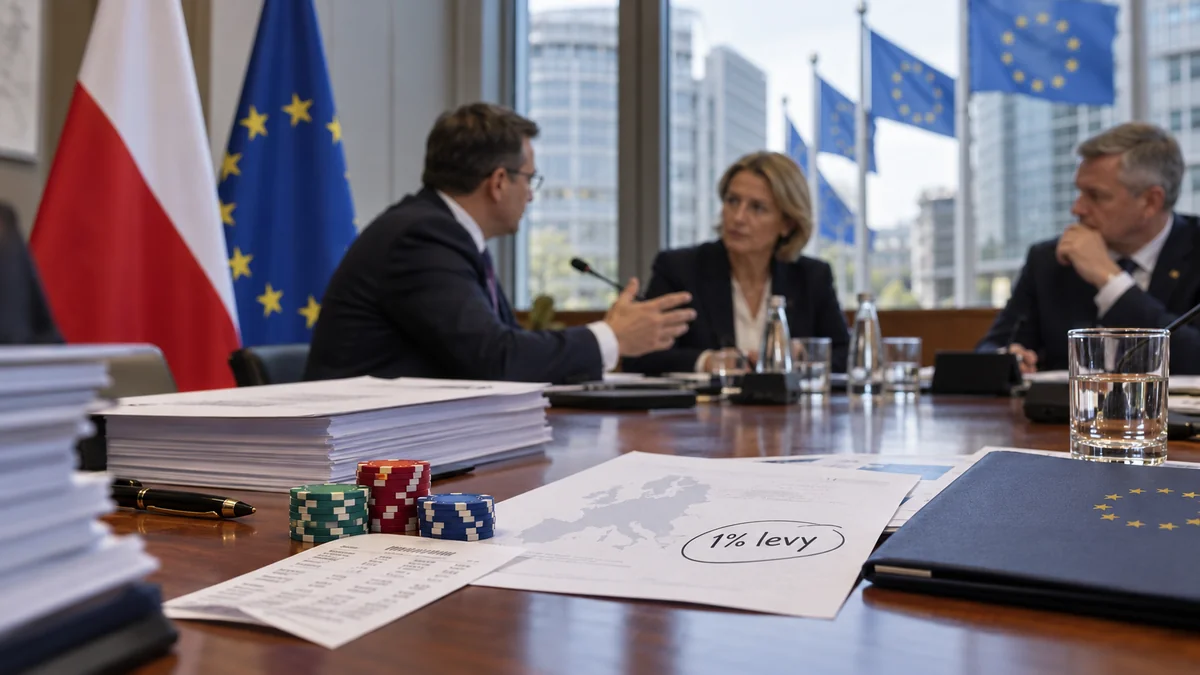
Four of Poland's largest gambling trade associations have put their names to a joint position paper rejecting any EU-wide gambling tax — and warning Brussels that levying licensed operators without first harmonising market rules would hand the advantage to unlicensed sites.
Key takeaways
- Four Polish trade bodies jointly oppose a 1% EU-wide levy on licensed online gambling
- The proposal comes from Victor Negrescu, Vice President of the European Parliament, as a revenue source for the 2028-2034 budget framework
- Polish licensees already pay 12% tax on turnover, which can swallow more than 50% of GGR
- The signatories say a tax without uniform EU market-access and enforcement rules would grow the shadow economy and cut state revenues
- Malta and the EGBA have already opposed the levy; adoption would require unanimity among Member States
A 1% Levy With Growing Momentum in Brussels
The idea surfaced at the start of 2026, when Victor Negrescu, Vice President of the European Parliament, floated a blanket 1% tax on Europe's licensed online gambling sector. The aim is to raise billions of euros as one of several new income streams feeding the Union's 2028-2034 Multiannual Financial Framework.
Rather than fading away, the proposal has been picking up support. In June, Negrescu's office confirmed that it had not been rejected and was gaining traction across political levels in Brussels. Piotr Serafin, European Commissioner for Budget, Anti-Fraud and Public Administration, subsequently said the Commission is weighing every budgeting option — the collective gambling levy included.
Opposition has been building in parallel. Malta has already pushed back, as has the European Gaming and Betting Association (EGBA). Poland's industry has now joined them.
"Harmonise Everything, Not Just the Tax"
The four organisations say they "strongly" oppose a joint EU gambling tax, on the grounds that it would not only add financial weight to the sector but also distort fair competition.
They also point to a gap between the two EU institutions: the gambling levy did not feature in the Commission's original budget package presented in 2025, yet the Parliament continues to push it as an extra source of revenue.
If European leadership does eventually put the tax to a vote, the Polish signatories argue it must be paired with uniform EU-wide rules shielding licensed businesses from unfair competition by illegal operators — in effect, the standardised European gambling framework long considered unachievable given how differently each Member State regulates the activity.
"It cannot be accepted that the European Union harmonises the tax burden, while leaving the Member States with very different regulatory models, tax levels and market access conditions, leaving them alone in the fight against gambling crime. Currently, in the European Union, no legal operator has the ability to operate in all member states, at the same time, this is how illegal entities operate."
— Joint statement of the four Polish trade bodies
Already Paying 12% of Turnover
On the fiscal argument, the statement notes that licensed operators in Poland hand over 12% tax on turnover — a charge that can eat more than 50% of an operator's gross gaming revenue, before the everyday costs of running a regulated gambling business are counted.
"As a result, the additional tax may lead to a decrease in the competitiveness of legal operators, an increase in the attractiveness of illegal websites for consumers, and thus the outflow of some players to entities operating outside the law and a further increase in the shadow economy. This, in turn, will result in a reduction (rather than an increase) of the state's tax revenues."
— Joint statement of the four Polish trade bodies
There is precedent for that warning inside the EU. The Netherlands saw its gambling tax take fall even after raising rates — the outcome the Polish bodies say Brussels risks repeating on a continental scale.
A Counter-Proposal, Not a Refusal
The signatories are careful to say they do not dispute the right of the Union or its Member States to set fiscal policy. Their objection is to loading further obligations onto licensed businesses while doing nothing to level the playing field.
Their alternative package asks for three things:
- Uniform market-access rules for legal operators across the EU
- Enforceable EU-wide consumer protection standards
- Sharper tools against the black market
"Only this approach will make it possible to achieve the goal of simultaneously ensuring public revenues, protecting citizens, developing a legal market and effectively limiting the activities of illegal operators."
— Joint statement of the four Polish trade bodies
Who Signed It
The position carries the backing of the boards of the Polish Chamber of Commerce of the Entertainment and Bookmaking Industry, the "Bukmacherzy Razem" Association, the "Play Legally" Association and the Association of Employers of the Entertainment and Gaming Industry.
What Happens Next
Neither the Commission nor the Parliament can impose an EU gambling tax by itself. The proposal would have to go before the Member States, where unanimous agreement is required for adoption — and with Malta already on record against it in Brussels, that unanimity looks a long way off.
Even so, the debate may leave something behind. The push for closer regulatory harmonisation across the bloc, which Poland's operators are explicitly asking for, could end up laying firmer ground under Europe's licensed gambling sector than the levy that started the argument.