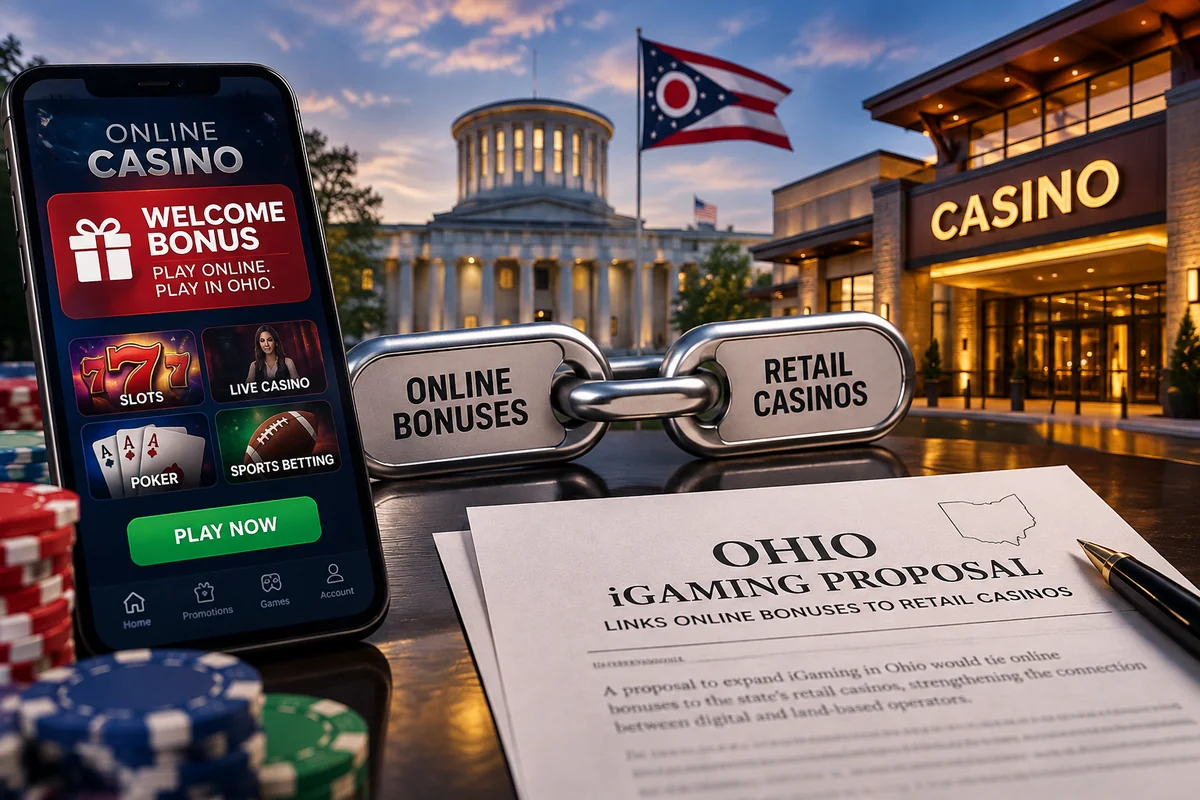
Ohio's online casino debate has produced an unusual idea: legalise iGaming, but make the bonuses work against it. State Representative Brian Stewart wants operators barred from handing out promotional credits for online play, and permitted to offer incentives only if they are redeemed inside one of the state's brick-and-mortar gaming venues.
Key takeaways
- Online promo credits would be banned; bonuses would be redeemable only at land-based casinos.
- iGaming licences would be limited to Ohio's 11 existing casinos and racinos.
- HB 298 proposes a 28% tax on internet gambling receipts and a $50 million initial operator licence fee.
- 1% of net online gambling revenue would go to the Problem Gaming Fund.
- The bill sits in the House Finance Committee and has not passed the Ohio House.
The concept belongs to the ongoing negotiation around House Bill 298, sponsored by Stewart together with Representative Marilyn John. The bill would legalise and regulate internet gambling across Ohio while shutting down online sweepstakes-style games. As of 21 September it remains parked in the House Finance Committee with no floor vote recorded.
Stewart laid out the promotional mechanism during a panel hosted by the iDevelopment and Economic Association.
"We would say that you can't offer online promotional credits. You can offer promotional credits, but they need to be credits for the land-based casino."
— Brian Stewart, Ohio State Representative
In practice, that turns the bonus from a customer-acquisition tool into a footfall-driver. An operator could still dangle an incentive in front of an online player, but the player would have to walk into a physical property to use it. Ohio currently counts 11 casinos and racinos that would qualify for a licence under Stewart's framework, including venues run by Caesars, Hard Rock and PENN Entertainment.
Licences Reserved for Incumbents
The promotional restriction travels alongside a second limitation: online casino licences would be available only to businesses already tied to Ohio's existing casinos and racinos. Stewart has been open about the political arithmetic behind that choice — without the land-based sector on board, he argues, an iGaming bill does not survive its first week.
"If I introduce a bill and it immediately becomes this turf fight amongst all the different gaming interests, it's dead on Day 1."
— Brian Stewart
The reasoning draws directly on what Ohio watched happen with sports betting. Once legal wagering launched on 1 January 2023, FanDuel and DraftKings arrived with national databases and promotional budgets that local operators simply could not match, and the online market tilted accordingly. Stewart's design is an attempt to stop that pattern repeating in the casino vertical — by removing the weapon rather than the competitor.
It would also create an odd regulatory patchwork. Ohio already permits promotional gaming credits inside land-based casinos under state supervision, and licensed sportsbooks run their promotions under a separate rulebook. A third regime, in which online casino incentives exist but can only be cashed in offline, would be unlike anything in the neighbouring states.
The Numbers Behind the Bill
As introduced, HB 298 carries a 28% tax on internet gambling receipts and a $50 million fee for an initial internet gambling operator licence — a barrier that reinforces the incumbent-only structure on its own. The Legislative Service Commission's fiscal analysis expects legal online gambling to add hundreds of millions of dollars a year to the General Revenue Fund, with 1% of net revenue routed to the Problem Gaming Fund.
Stewart has pointed to projections of up to $400 million annually for the state, a figure that has made iGaming attractive to Republicans looking for ways to fund cuts to — or the elimination of — Ohio's income tax.
"A lot of folks will hold their nose if they believe that this is a significant way to achieve other budget priorities."
— Brian Stewart
Geography strengthens the revenue argument. Michigan, Pennsylvania and West Virginia all run competitive regulated iGaming markets on Ohio's doorstep, and legalisation supporters routinely cite the money crossing state lines as a reason to build a domestic market instead.
Not every voice in the debate is enthusiastic. Responsible gambling advocates have flagged the risks that come with always-available online play, and parts of the land-based industry have raised familiar worries about cannibalised floor revenue and jobs — which is precisely the anxiety Stewart's retail-redemption clause is engineered to answer.
Still a Committee Problem
Ohio has expanded gambling twice before by two different routes: voters approved casinos through a constitutional amendment, while the legislature built the sports betting framework itself. Neither precedent guarantees a smooth path for iGaming, and Stewart has acknowledged that the fault lines run inside his own party despite comfortable Republican majorities in both chambers.
"Why the hell can't I play poker too?"
— Brian Stewart, on Ohio's existing gambling menu (via Covers)
For now the retail-promotions idea is a negotiating position rather than statutory text: it is not in the introduced version of HB 298, which is still waiting on committee consideration before it can reach a House vote. Whether the concept survives into a final bill — or gets traded away to secure votes — is likely to say a lot about how much leverage Ohio's land-based operators really hold.